



Continued From Spalatum – Part I
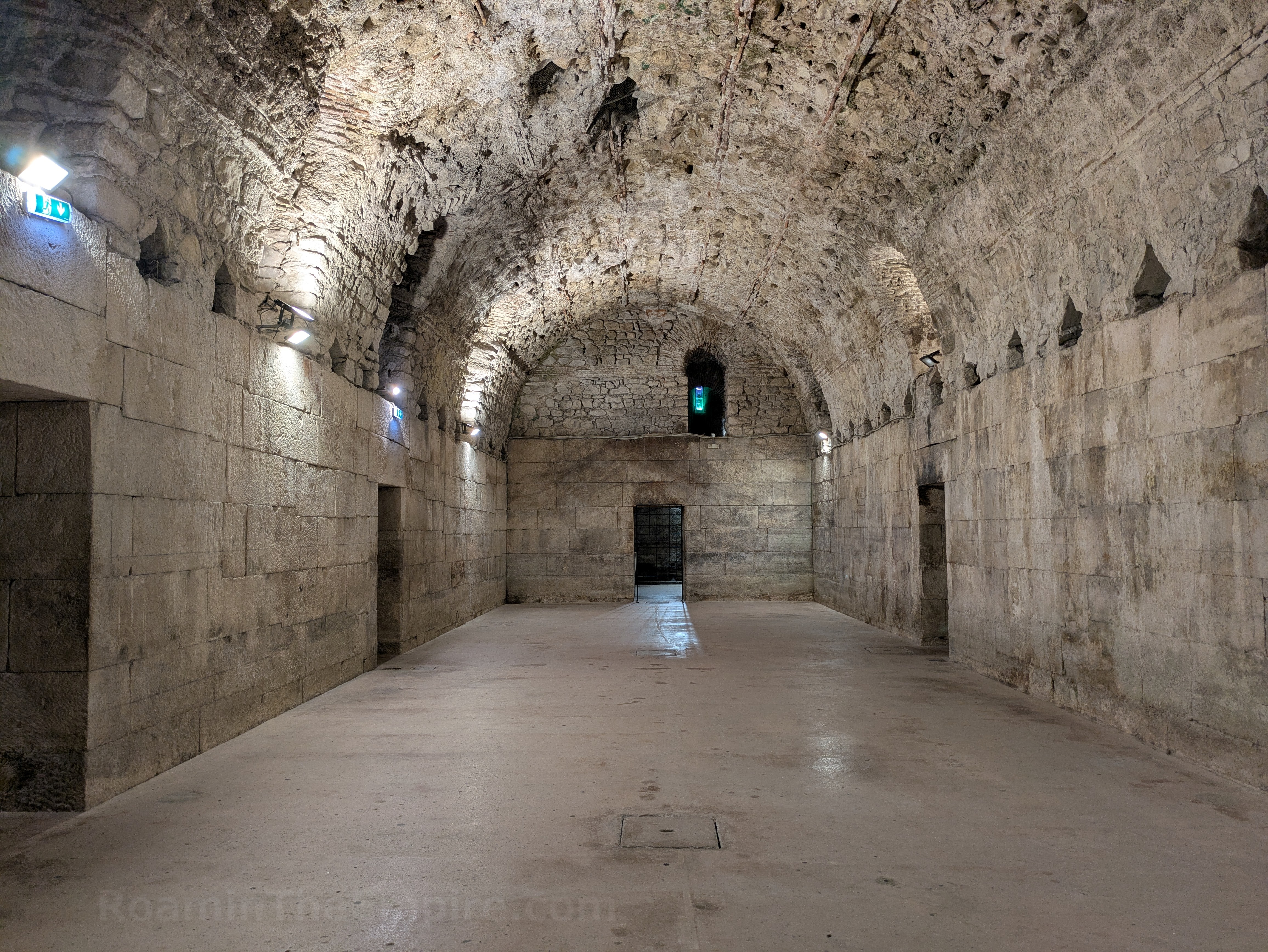
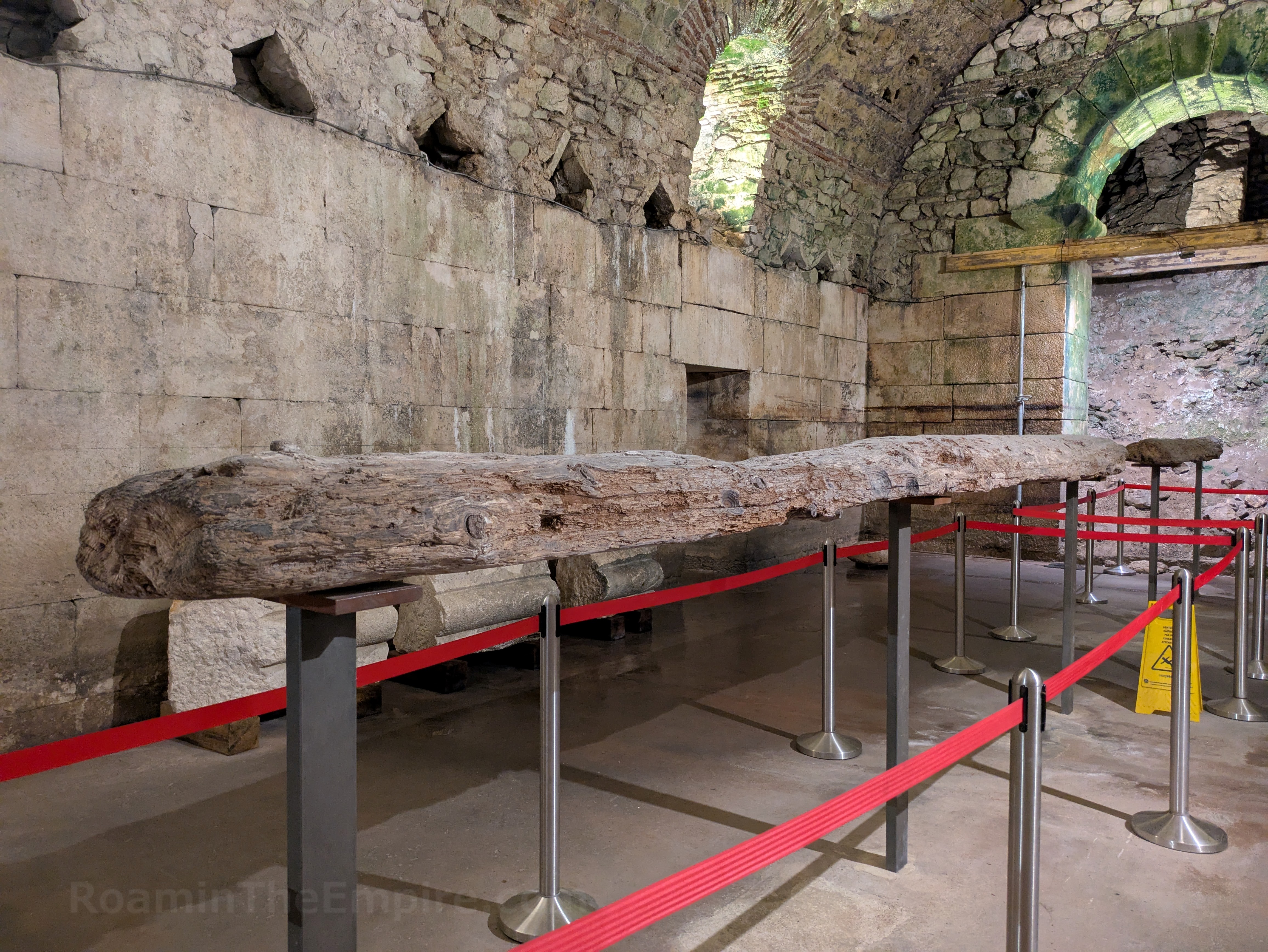
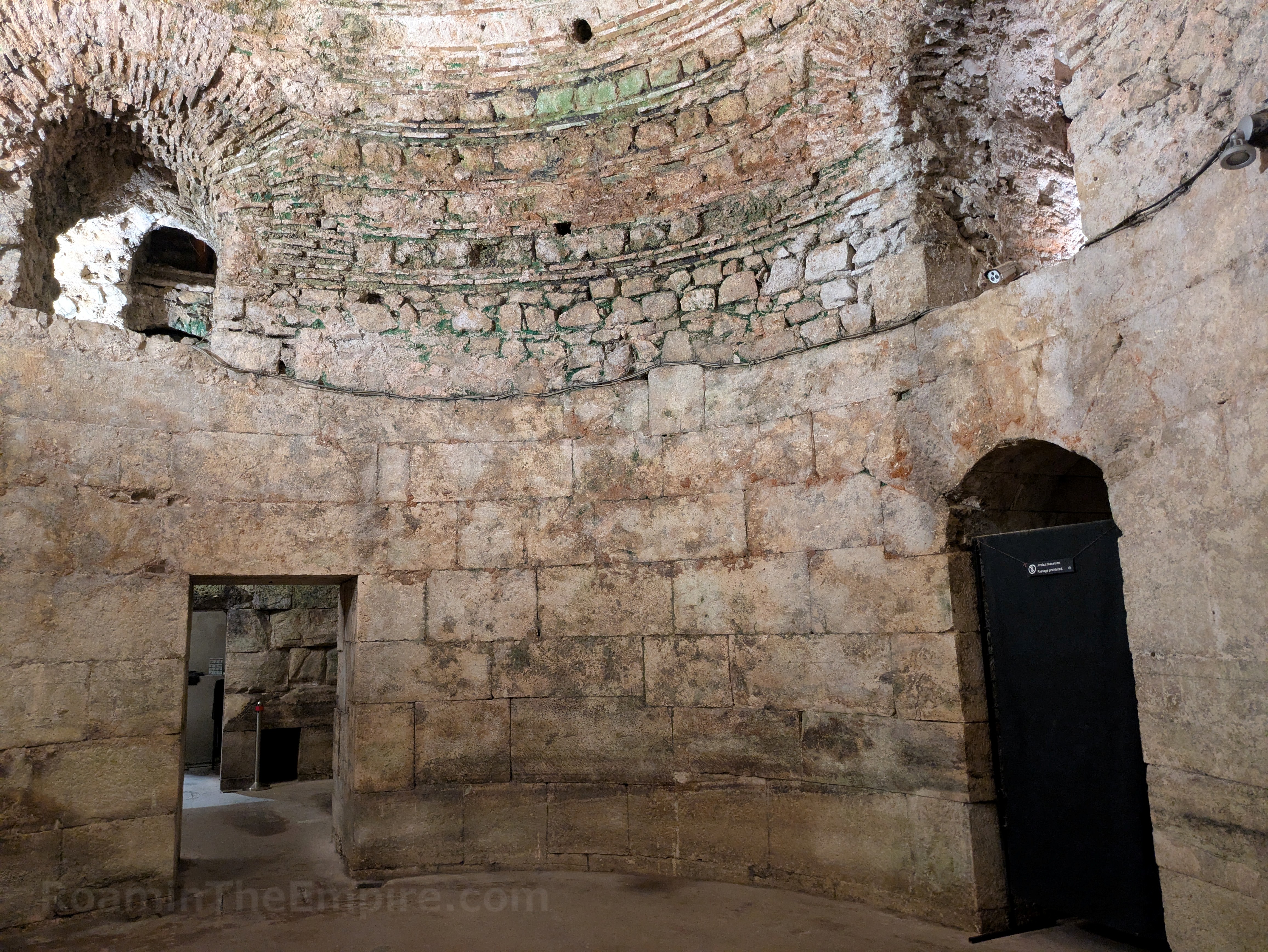
Through the west side of hall 6a of the basement area of Diocletian’s Palace are two portals (directly opposite the two on the east side of the room) that lead to another small ventilation corridor (corridor 5). Unlike corridor 7, this opens back up to hallway Y at the south. At the north end of the hallway, there is also a doorway that leads west in to a cruciform room (4b) that is somewhat inaccessible from this doorway; it is partially blocked by the reconstruction of pieces a medieval oil press found in the room, though one could get through if there was a strong desire to. The room is also accessible from the other side. The two doorways from hall 6a lead through corridor 5 and into another, smaller apsidal hall (4a). Wooden beams from the floor of this hall, which supported a scaffolding system that was used to construct the vaulted ceiling of the hall, were found in situ and are now on display in an adjacent room (2c, accessible through the northwest doorway).

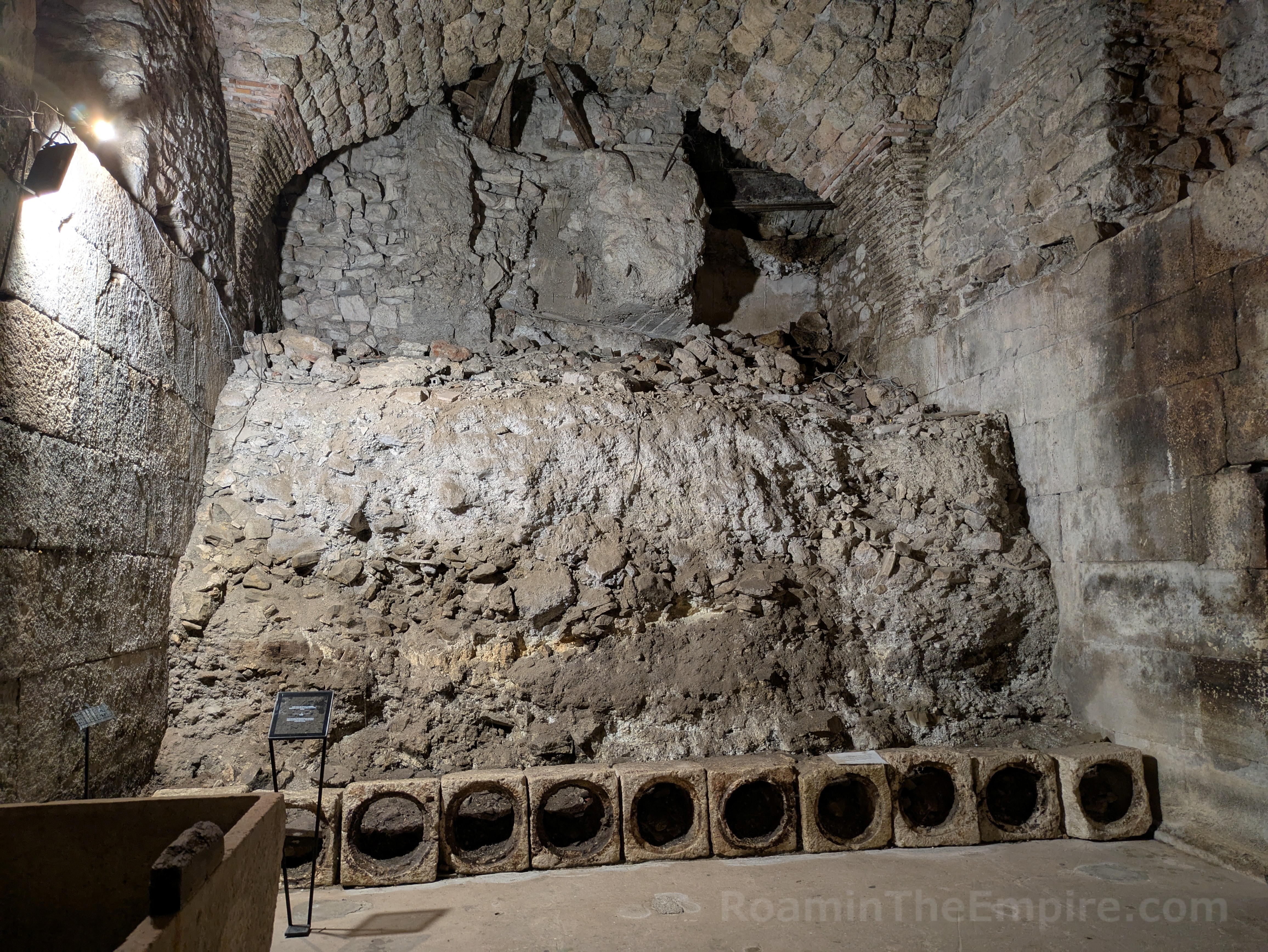
The two doors in the east wall of 4a lead to a series of eleven more rooms of various sizes and shapes; cruciform, square, apsidal, circular. There are a few other rooms that exist, but are not presently excavated and are filled with rubble. Some of these rooms contain exhibits; in addition to the medieval oil press and wooden beams, there is a 4th century sarcophagus, blocks from stone piping, and various other architectural fragments. Back in the main hall is a topographic map of the area and some pictures of the excavations of the basements. Many of the rooms, including the large halls, are interconnected with additional upper passages between the rooms, presumably to increase airflow within the basement.
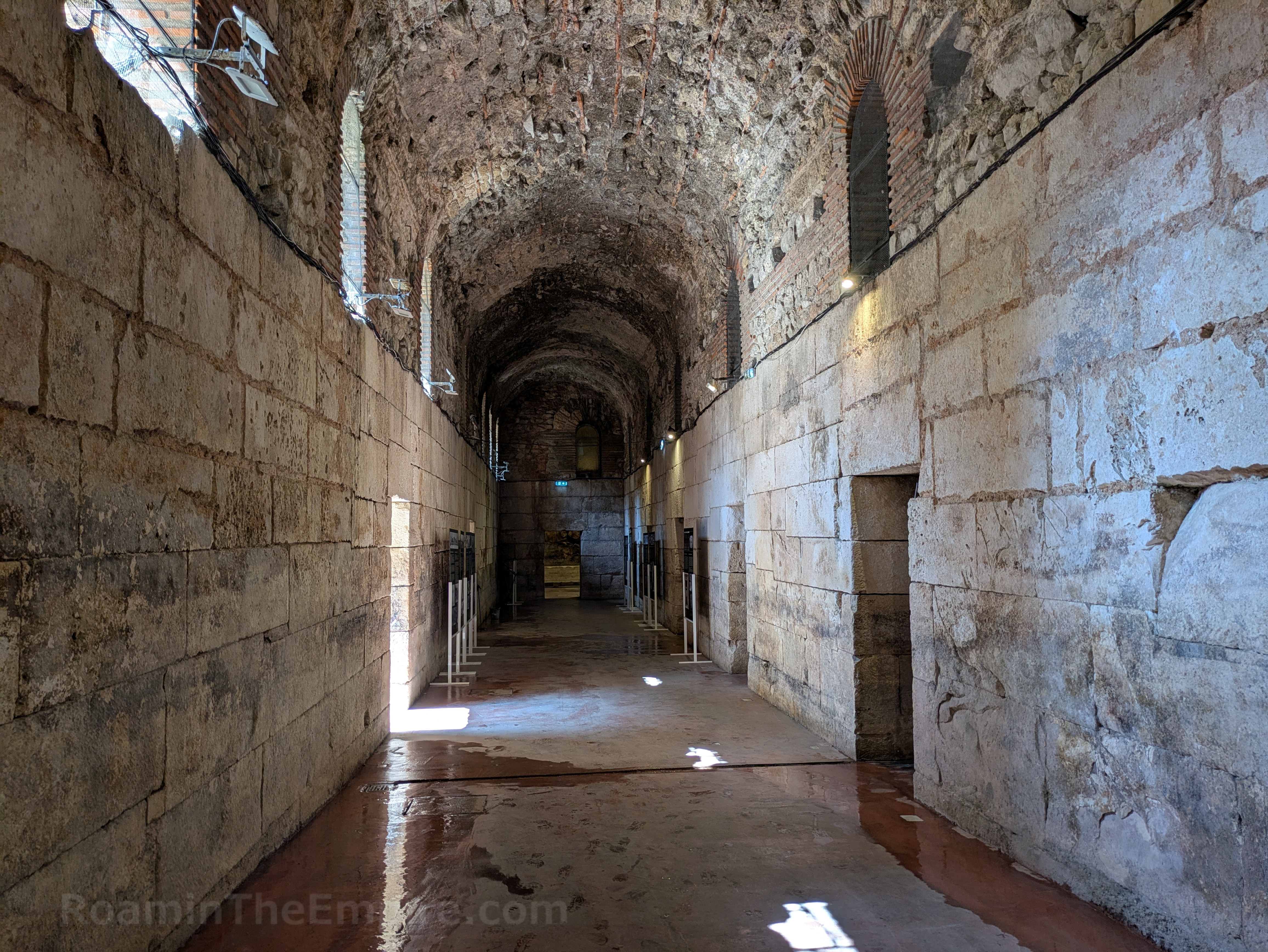
After finishing the western basement area, access is granted to the eastern portion of the basement with the same ticket. The first passageway off the main hallway in the east is a corridor (corridor 14) that mirrors corridor 8 on the west side with a series of 6 small rooms (13a-f). A number of informational boards are on display in the corridor, and each room contains an exhibit on the decorative motifs of the palace: marbles, architectural elements, the coffered ceiling of the mausoleum, sphinx. Corridor 8 leads into an east-west corridor (corridor 17e), but this is blocked off several meters east of the junction of the two spaces.

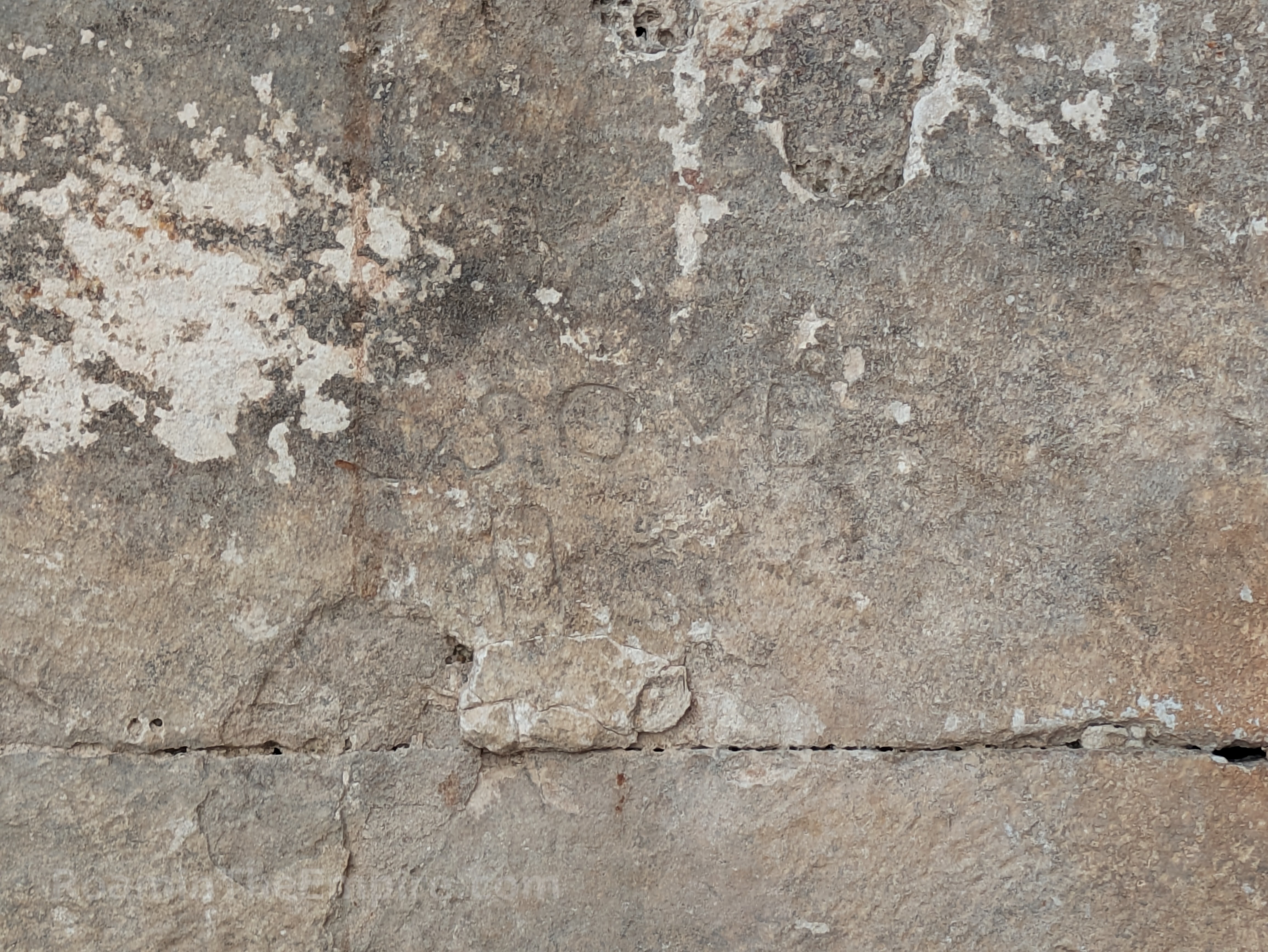
Two doors from corridor 8 lead out into open air courtyard areas. The northern of these two passages leads out into courtyard 15c. Evidence collected here suggests the area was used for commercial purposes prior to the construction of the palace, though it also seems to have had a religious nature. After the palace was constructed, the space seems to have retained the religious nature. The eastern part of the courtyard was occupied by a preexisting pool faced in waterproof mortar and white mosaic tile. Not much remains of the pool today other than small fragments of the mortar and tesserae. A channel then led to the south toward room 16b off the south side of the courtyard. Along the wall where the channel would have passed into room 16b is an inscription on the east wall: HVC V SOVE, reconstructed as Hunc Votem Solverunt; they fulfilled this vow. Really only the SOVE is visible from the inscription, though. In room 16b was a small stone bowl into which the channel led, but that is now covered and not visible. A small bit of rock in the northwest features a stone element of an olive oil press, though no dating is given for it.

A small corridor (15b) links to a smaller southwestern courtyard (15a), but it is not directly accessible. Room 16b, essentially between courtyards 15c and 15a, is one of three more or less identical cruciform rooms on the west (16b), north (17c), and east (18b) sides of a larger central octagonal hall (17b). The smaller rooms interconnected with the four courtyards around the room and the central room. Room 18b was destroyed however and is not accessible (along with the flanking northeast and southeast courtyards; 19c and 19a, respectively), though 16b and 17c remain and are accessible. Room 17b underlies the identical triclinium of the imperial residence. To the south of the octagonal are a series of three small interconnected rooms (16a, 17a, 18a), though the octagonal hall only directly connects to the central of these three, 17a. These three rooms then lead back into the main hallway (hallway y) to conclude the area of the eastern basement. Throughout the basement archaeological area, there are frequent informational signs in English and Croatian with maps and diagrams.

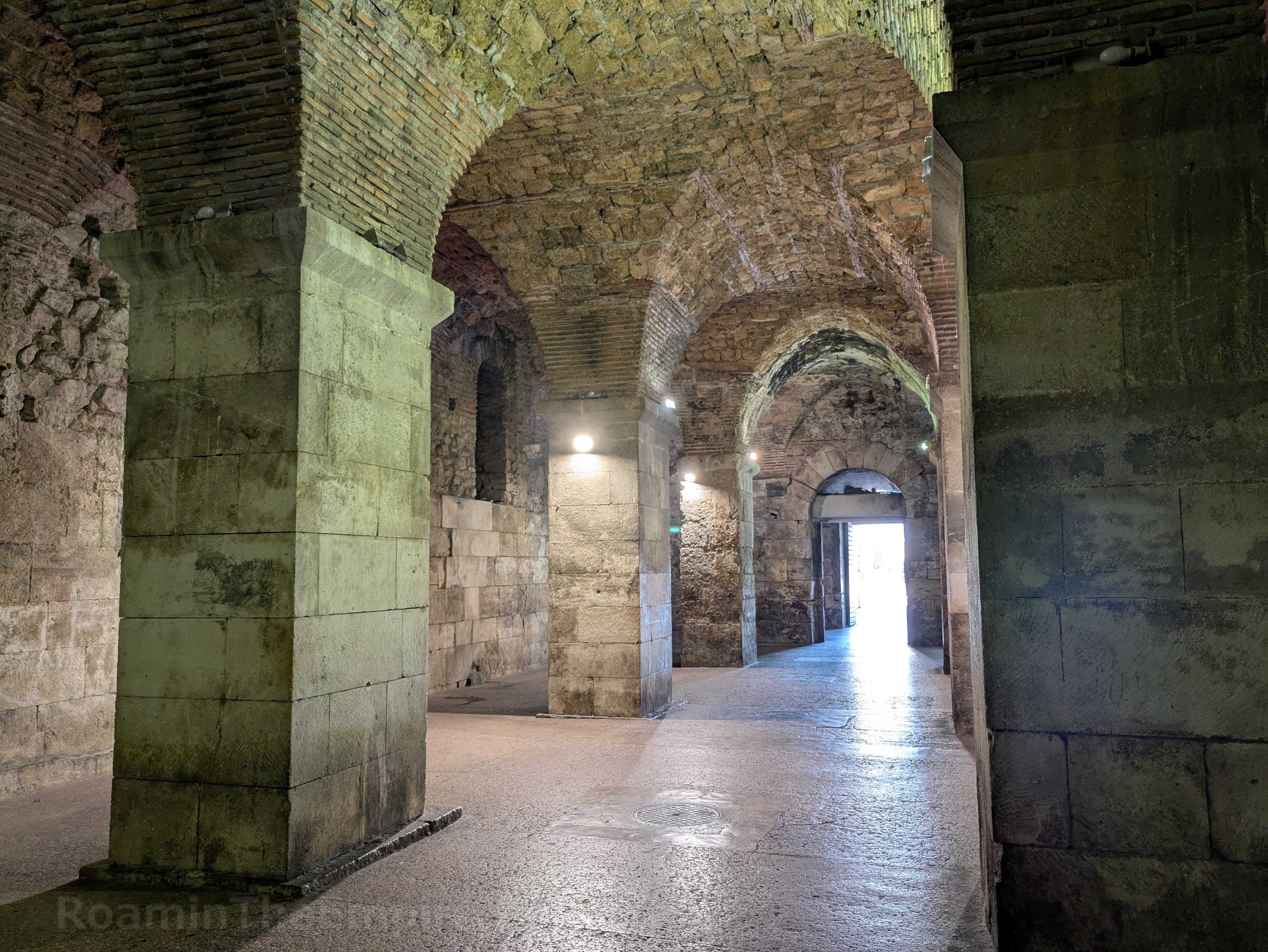
Back to the main hallway and directly opposite the entrance from the Bronze Gate is another large hall (11a, sometimes referred to as the Emperor’s Ditch), which is open access and not part of the archaeological area. Like the other larger halls in the basement, it has vaulted ceilings which are supported by a series of eight square pillars to create a triple nave layout. A few mason marks are visible etched into the blocks of the walls here, particularly on the east wall. This grand hall was used to communicate between the Bronze Gate and the peristyle of the residence, should guests arrive by sea. On the north side of the hall, a few stairs lead up to a landing area with exits to the north, east, and west.

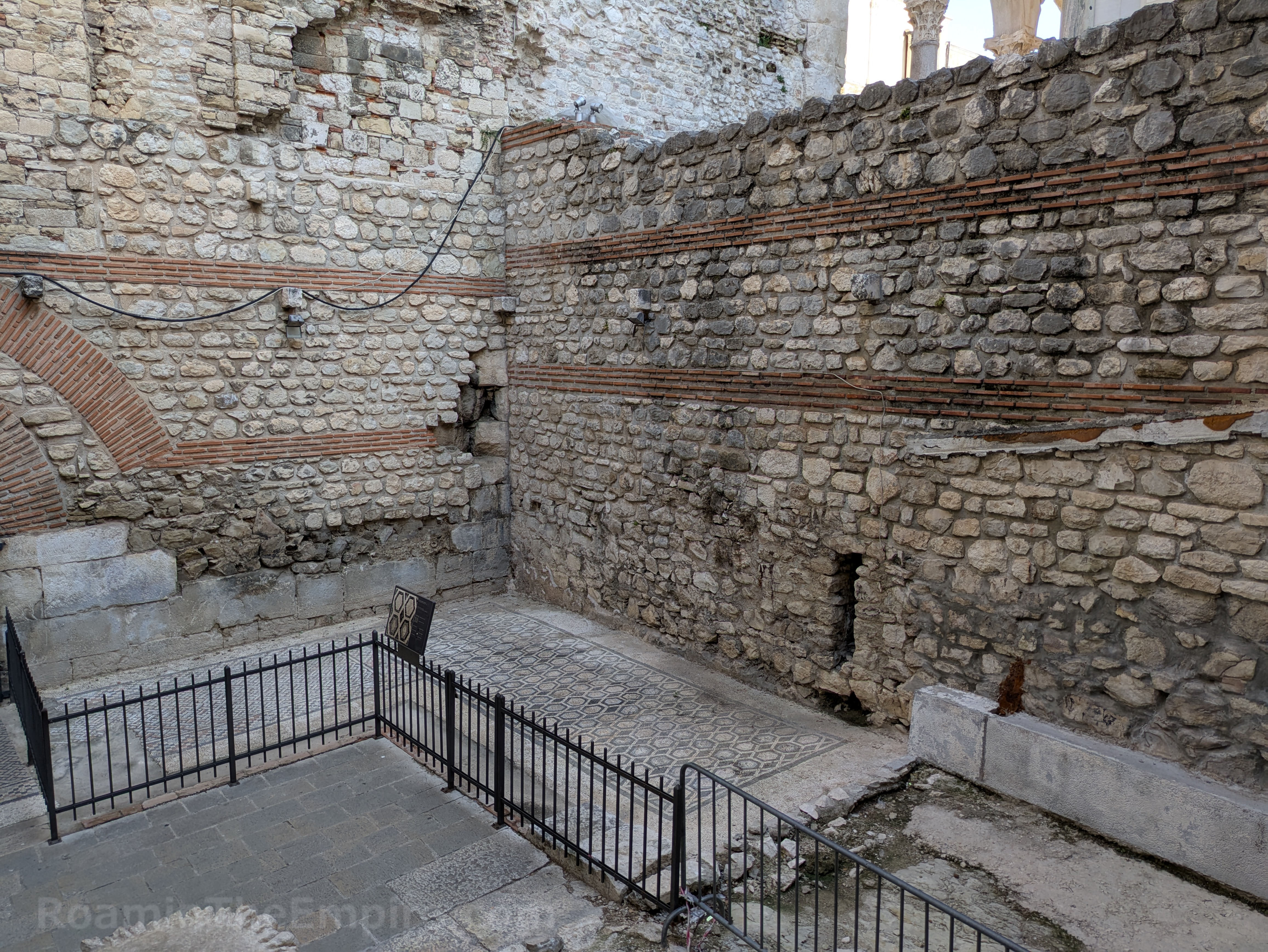
The stairway from the landing to the right (east) leads to a small courtyard area. The walls on the north and west sides of the courtyard bear the hallmark brick patterns of Roman work, though the west wall at least seems to be partially newer reconstruction of the pattern. A significant portion of the floor of the courtyard is covered by geometric mosaics. Some of it is fenced off for protection, but other parts are open. There’s a small sign that explains these mosaics date to the 5th century CE, notably after the construction of the palace. The function or use of the area seems to be that of a service area.
Back to the central landing, the western exit leads up a staircase and into an alleyway or small pedestrian street. There is nothing especially noteworthy about this area, though there is a sunken area along the south side of the street. Along the south side of this area, both the ashlar block walls that comprised the structure of the basement area as well as the brick walls of the main palace level can be seen. A doorway is also present in the ashlar block section of the wall. Again, the exact use of this area is unclear. A few meters down the walkway, the remnants of a brick column are visible with the lower portion seeming to have been reconstructed. This may be another service area of some sort.

Once again back to the central landing, a larger staircase leads to the north and opens up into the monumental peristyle of the palace. This is perhaps the most famous and easily recognizable portion of the palace. This area was essentially the southern extension of a road that served as the cardo maximus of the palace, on an axis between the southern Bronze Gate and the northern Golden Gate. The area is slightly sunken with a few steps leading down from the north, east, and west. The east and west sides of the peristyle are colonnaded. The columns and entablature on the west side are incorporated into the later buildings. The eastern colonnade is still mostly freestanding and reconstructed, with the columns and an arched entablature topping them.

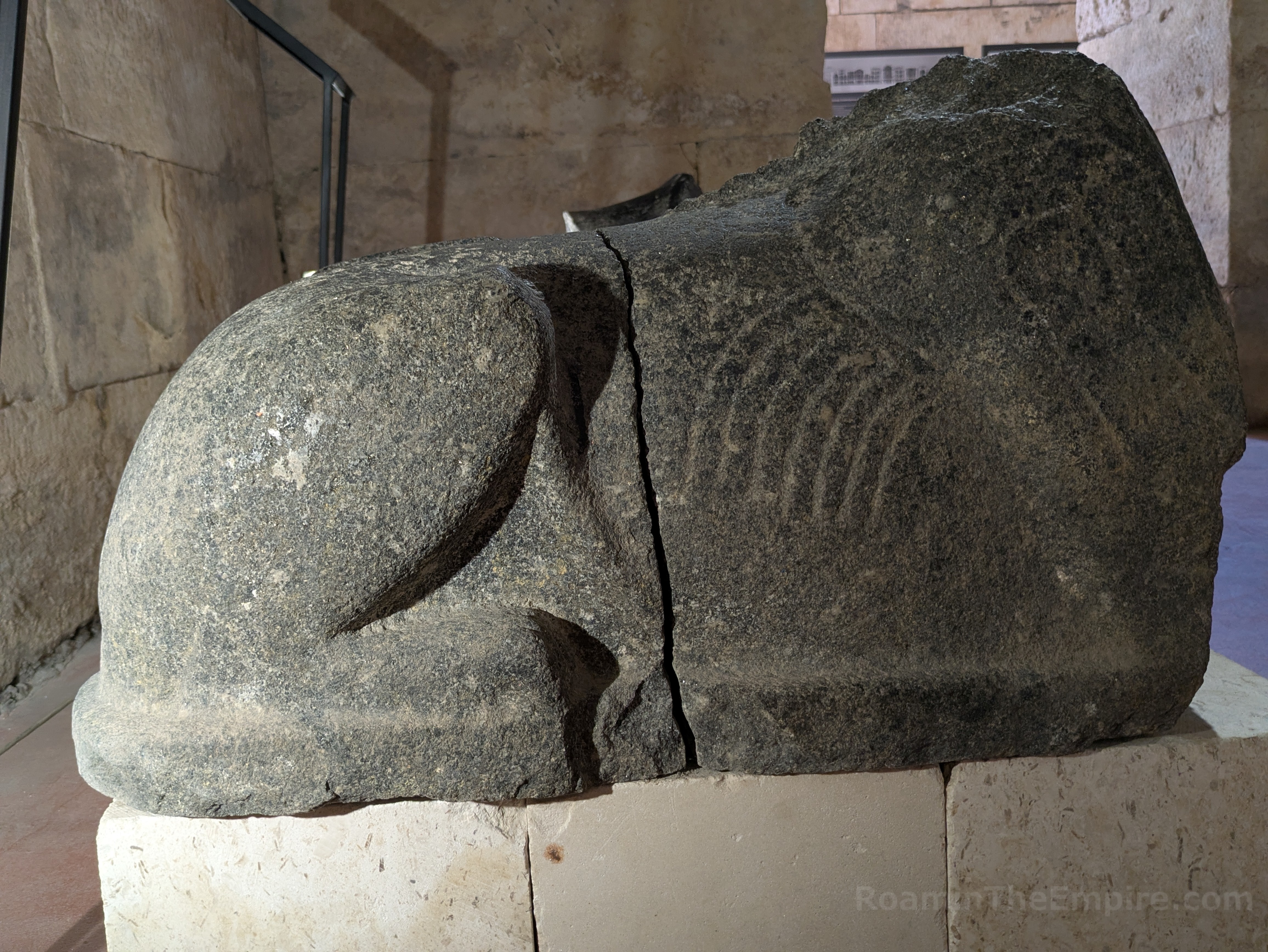
On the north side of the peristyle is a monumental prothyrum that served as the entrance to the emperor’s residence. An eight-step stairway leads up, on either side of the stairway down into the basement substructures, to the prothyrum. The entablature and architrave sit atop the columns, giving the entrance to the emperor’s residence the appearance of the front of a temple. Flanking the prothyrum, below the final arch of the eastern colonnade, is a basalt sphinx. This is one of at least a dozen sphinx brought from Egypt to the palace, possibly mementos of his campaigns in Egypt during the construction of the palace. Pieces of other sphinx are on display in the eastern basement rooms. This particular sphinx dates to the reign of Tuthmose III (1479-1425 BCE) and is the most complete on display at the palace.
Continued In Spalatum – Part III





Sources:
Brcic, Inga Vilogorac. “Venus et Cybele. Matres Romanorum,” The Century of the Brave: Roman Conquest and Indigenous Resistance in Illyricum During the Time of Augustus and His Heirs. Stoljeće Hrabrih (Ed.), FF Press: Zagreb, 2018.
Bužančić, Radoslav. Diocletian’s Palace, 2009.
Bužančić, Radoslav. “Diocletian’s Palace, Restoration of the S–E Quadrant.” 50 Years (1972–2022) of the Convention Concerning the Protection of World Cultural and Natural Heritage, 2024.
Smith, William. Dictionary of Greek and Roman Geography. Walton & Murray, 1870.
Stillwell, Richard, William L. MacDonald, and Marian Holland. McAllister. The Princeton Encyclopedia of Classical Sites. Princeton, NJ: Princeton U Press, 1976.
Grant, Michael. A Guide to the Ancient World: A Dictionary of Classical Place Names. New York: Barnes & Noble Books, 1997.