


Most Recent Visit: August 2024
Perched in the hills above modern Florence is the town of Fiesole, successor to the ancient settlement of Faesulae. Archaeological evidence suggests the hill, which offers a defensible position above the confluence of the Arnus (modern Arno) and Munio (modern Mugnone) rivers, near where the later Roman settlement of Florentia (modern Florence) would be built, has been continuously occupied as early as the Archaic period. There has also been material found from earlier periods going back as far ast the 13th century BCE, but the amount seems to indicate that the settlements of those periods may have been located on adjacent hills, rather than the two on which Faesulae sits.
The Etruscan settlement, founded sometime between the 9th and 7th centuries BCE, was called Viesul (or Vipsul or Visl) according to the discovery of a series of boundary stones bearing these names and associated with the city. It is possible that it was established as a colony of Volaterrae (modern Volterra). In the late 6th or early 5th century BCE, a synecism incorporated dispersed populations in the area into the settlement. By the 5th century BCE, Faesulae had developed into an important trade and communication hub for the Etruscans, as well as an integral part of the defensive network against the Celts north of Etruria. The construction of a circuit of defensive fortifications in the 4th century ore early 3rd century BCE attests to the latter point.

It is generally accepted that Faesulae came under Roman control by 283 BCE, following the defeat of the Gallic-Etruscan forces at Lake Vadimo and the subjugation of much of Etruria to Roman hegemony. The Roman name for the settlement was derived from the Hellenized version (Φαίσολα) of the Etruscan name. Faesulae is first explicitly mentioned in the historical record in 225 BCE, when an invading Celtic force lured a Roman army into an ambush at Faesulae, dealing the Romans a heavy defeat. A few years later, in 217 BCE, Hannibal is noted as having encamped near Faesula, which was supporting Rome in the Second Punic War, and plundered the fertile agricultural lands extending southward toward Arretium (modern Arezzo).

During the Social War, Faesulae supported the Italian rebels and was conquered by Lucius Porcius Cato in 89 BCE. It is sometimes reported that the city was destroyed as a result of this action. In reality, it seems more likely that the city suffered destruction at the hands of Lucius Cornelius Sulla in 80 BCE for their support of the populares during Sulla’s Civil War. A colony of Sulla’s veterans was established at Faesulae shortly after. Faesulae continued their trend of supporting the losing faction in the civil unrest of the 1st century BCE by providing material support to Catiline in his attempted coup d’etat in 63-62 BCE. It was at Faesulae that the conspirator Gaius Manlius made his military headquarters and raised two legions for combat and to where Catiline fled after the plot was discovered in Rome. The legions were essentially cornered at Faesulae by Quintus Caecilius Metellus Celer and Gaius Antonius Hybrida before Catiline and Manlius were able to break out and engage in battle with Antonius at nearby Pistoria (modern Pistoia), where they lost and were both killed.

During the Roman period, Faesulae was renowned for its school of augurs. While sources report that a dozen youths of Rome were sent yearly to study divination in Etruria, it is often interpreted as specifically referring to Faesulae. Around the middle of the 1st century BCE, the city was given municipium, but by the time of Augustus had begun to be eclipsed in importance by Florentia. Faesulae is not mentioned again in the sources until 406 CE, when the Roman commander Stilicho broke the Gothic siege of Florentia by Radagaisus, causing the latter to retreat to Faesulae, where he was killed. The city was later taken by the Ostrogoths, but reconquered by the Byzantine general Belesarius in 539 CE, who was unable to take it by force, but eventually starved the Faesulae into submission.
Getting There: Modern Fiesole is not far from Florence, which is well connected as a rail hub as well as having an airport. The easiest way to get from Florence to Fiesole the bus. Bus #7 leaves from Piazza della Libertà (on the north side of the historic center of the city) several times an hour and terminates in Fiesole. The trip takes about 20-25 minutes and costs 2 Euros each way. Schedule can be found here. If driving, there is a good, free lot at Via degli Artigiani, to the east of the center. It is about a 5 minute walk from most of the remnants of Faesulae.

The visit in 2024 was my second time visiting Fiesole, with the first being in 2011. For the most part, I didn’t discern there as being much in the way of change between the two. The ancient remnants of Faesulae consist of a museum, unified archaeological area, and several ancillary free access sites. If arriving by bus from Florence, the bus drops you off in Piazza Mino; more or less the main piazza of Fiesole. The large paved area opens to the east onto some local government buildings on a terrace above the plaza. In the wall of the terrace, toward the south end, is a window that looks into a small stretch of basalt Roman paving stones, identified as the decumanus maximus of Faesulae. The road likely originally dates back to the 1st century BCE or 1st century CE. There’s a small informational sign in English and Italian in the window, but otherwise there is no indication the stretch of road exists; it’s easy to miss if you don’t know it is there.
Just around the corner from the decumanus maximus, leading out of Piazza Mino to the southeast, is Via Santa Maria. Incorporated into the wall of the first building on the southeast corner of this intersection is what appears to be a significant piece of ancient spolia. It is perhaps a column with some later alterations or possibly some other architectural element. The plaster that covers most of this face of the building is deliberately left open to expose the ancient element.

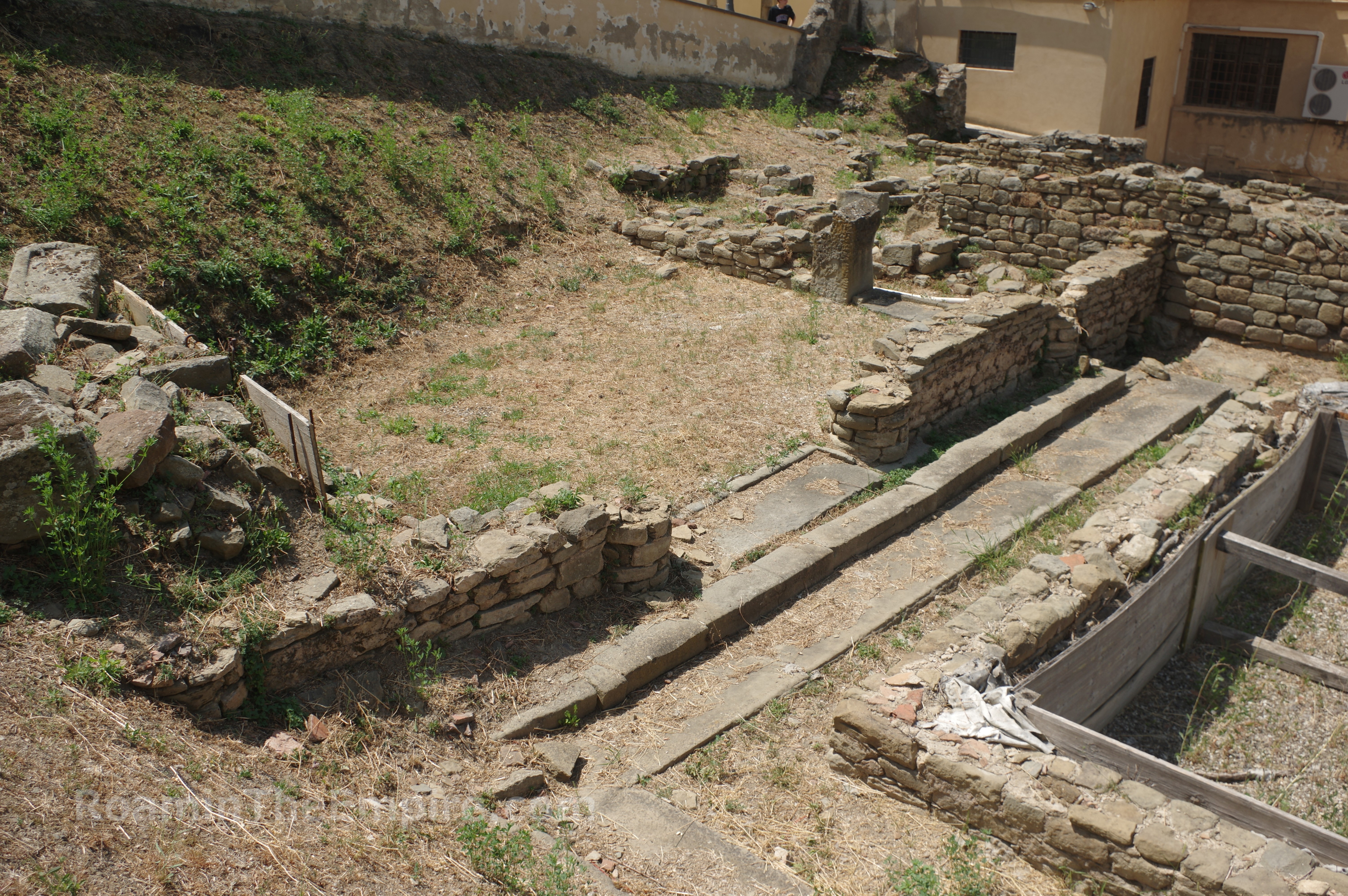
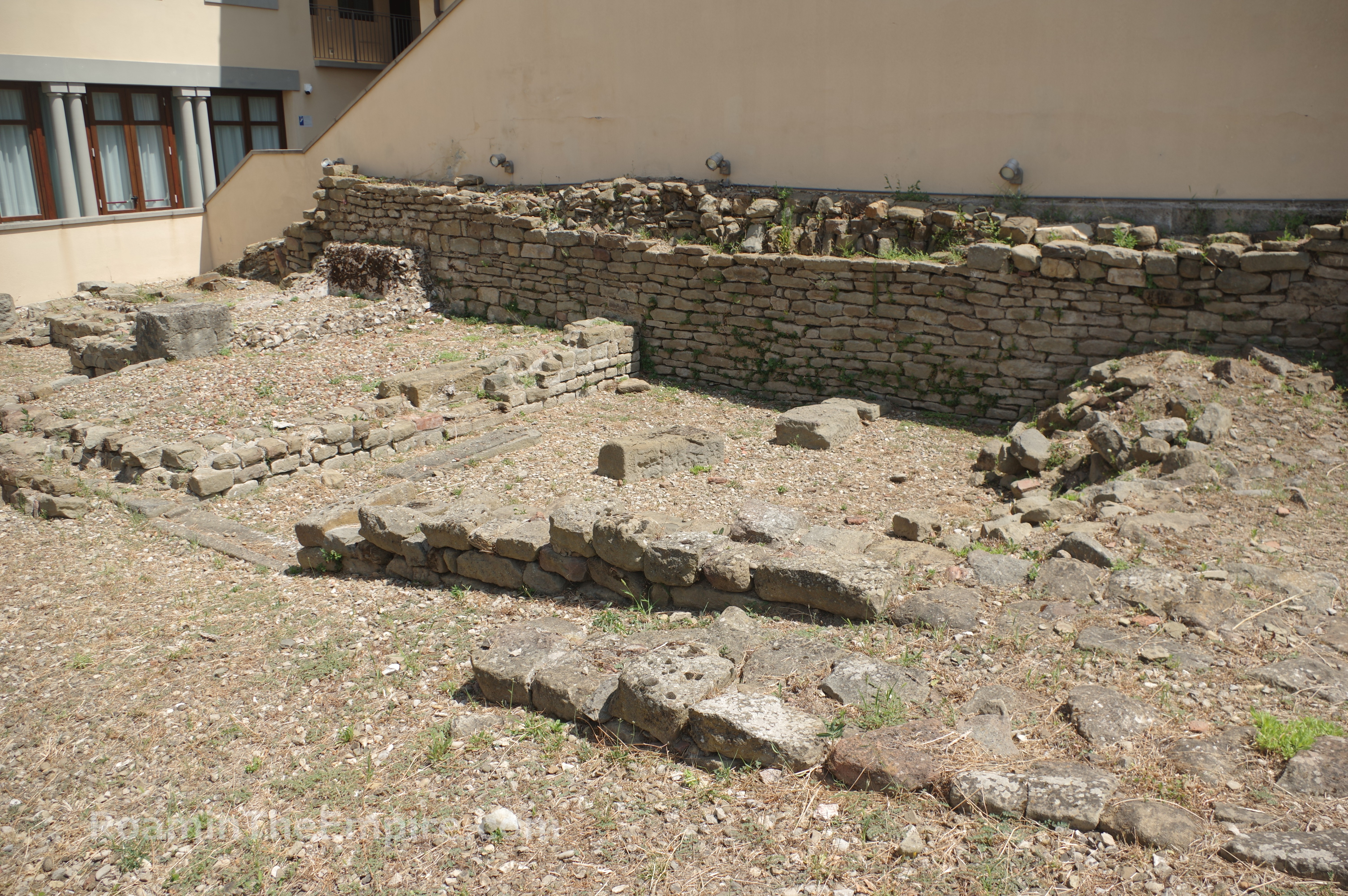
A few meters farther on Via Santa Maria is the southern entrance to the so-called Area Archeologica di Piazza Garibaldi, an archaeological area that is excavated in an area among several buildings and adjacent to the small Piazza Garibaldi, located to the north. This is a publicly accessible area, there is no ticketing nor seemingly any restrictions in access. There are gates at the entrances, but no hours are posted to indicate whether these close and open daily. There are two entrances; to the south off Via Santa Maria and to the north off Piazza Giuseppe Garibaldi (and the SP54). There’s no direct access to the archaeological remains, but rather a few pathways that criss cross the site.
The excavations here were buildings contained within a single insula that was located near the forum of Faesulae. It was bounded on the west by a Hellenistic terraced dating to the 4th or 3rd century BCE and on the south by the decumanus maximus. Sometime in the 1st century BCE or 1st century CE, a large domus was constructed through most of the area, including over the Hellenistic terrace wall. Elements of this home are particularly evident in the south part of the archaeological area, where a peristyle garden with a basin of some sort at the center are now visible. In the northeast of the site, some basins with cocciopesto lining indicate the area of a bathing complex associated with the house.

In the 3rd century CE, the house was converted into a commercial building, most commonly identified as a macellum. Most of the remnants of this period of construction are located in the northwest corner of the excavations. A number of shops opened into a central courtyard. Although not particularly visible, several Longobard graves were placed over and among the Roman buildings in the 6th and 7th centuries CE. Most of these are located between the two parallel walls on the west side of the domus. There are a few informational signs and diagrams of the site in English and Italian. The information of the English translations was very faded, nearly to the point of being illegible, when I visited.

Exiting the north side of the Area Archeologica di Piazza Garibaldi and on to the Piazza Garibalidi, the street more or less opposite the entrance to the site is Via Giovanni Pascoli. At the north end of this short street, where it intersects with Via Portigiani, on the southwest corner of the intersection, are a couple fragments of some ancient walls. This fenced area is the Giardino Mangani. It is open in January, February, November, and December every day except Tuesday from 10:00 to 15:00. In March and October it is open every day from 10:00 to 18:00. From April to September it is open every day from 9:00 to 19:00. There is no admission fee. Inside the area are two parallel walls that have been identified as being of Etruscan and Roman origin, and belonging to a portico that ran toward the forum, roughly corresponding to the area of the Piazza Mino.

From the Giardino Mangani, it’s a short walk about 100 meters west to the intersection of Via Giovanni Duprè and Via Portigiani, where the entrance to the Museo Civico Archeologico and the Area Archeologico di Fiesole are located on the north side. The museum and archaeological area have the same opening hours: the are open in January, February, November, and December every day except Tuesday from 10:00 to 15:00. In March and October, open every day from 10:00 to 18:00. From April to September they are open daily from 9:00 to 19:00. Admission to just the archaeological area is 7 Euros, while a combined ticket to both the archaeological area and the museum is 10 Euros. The adjacent Museo Bandini, a mostly medieval art museum, can also be added for a combined ticket of 12 Euros. Oddly, there is not a separate single entrance for the Museo Civico Archeologico.
The museum is kind of deceptively large; it doesn’t look like much from the outside, but there’s a lot of material packed into it. The layout and organization are a little dated, but still useful. There’s lots of information in both Italian and English and despite feeling a little dated, the presentation is done well within that framework and objects aren’t just kind of jammed into cases.

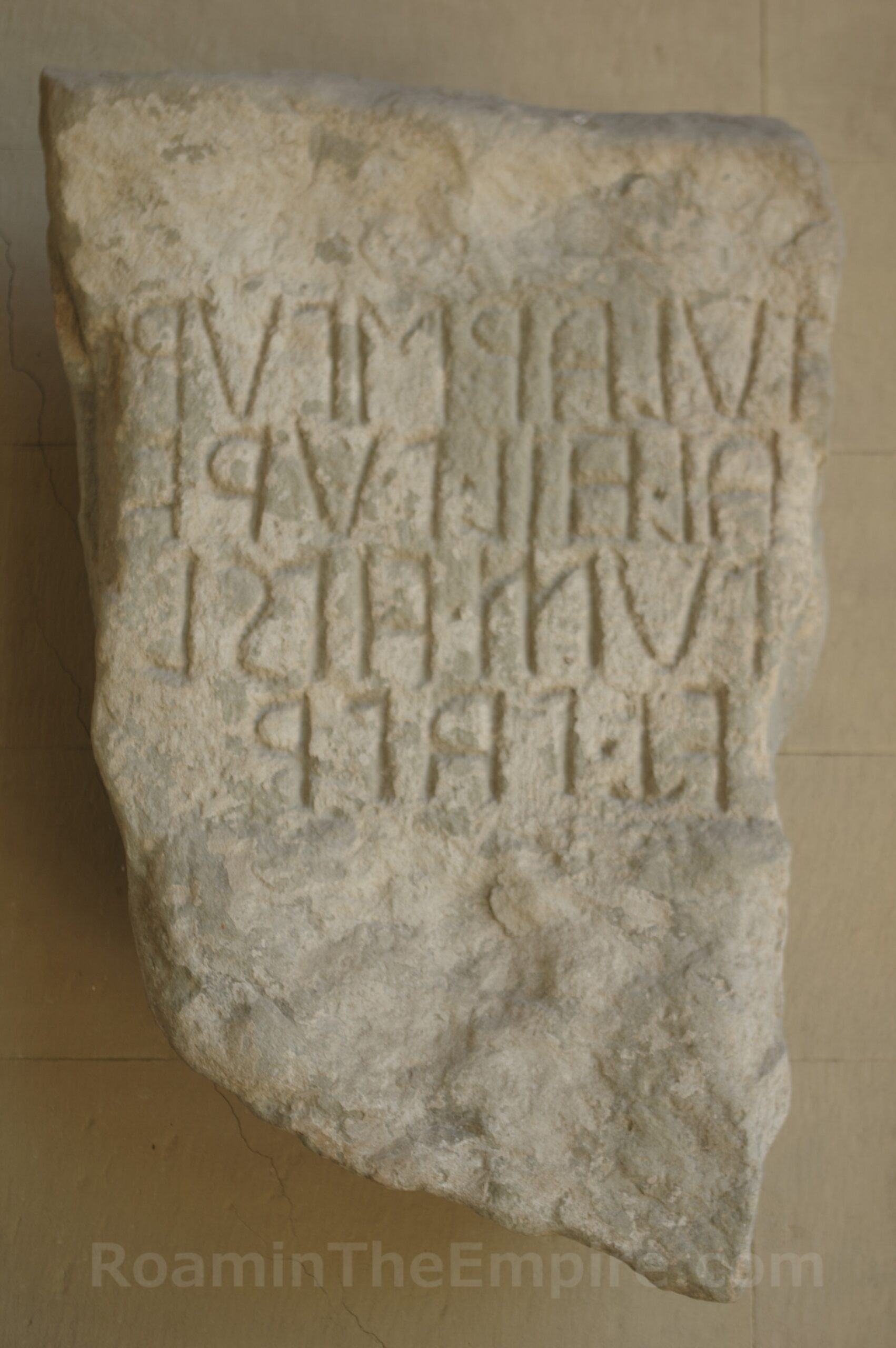
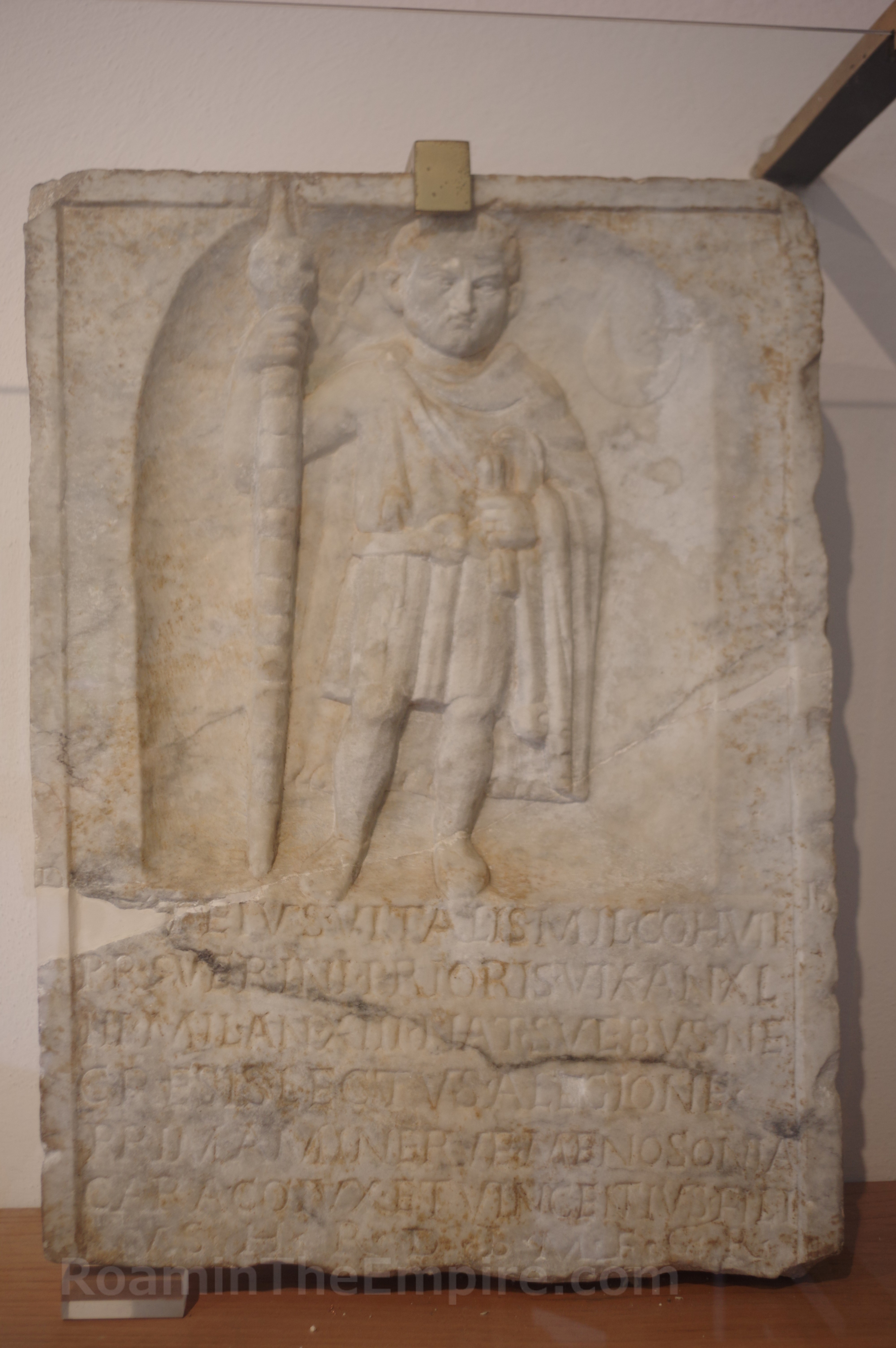
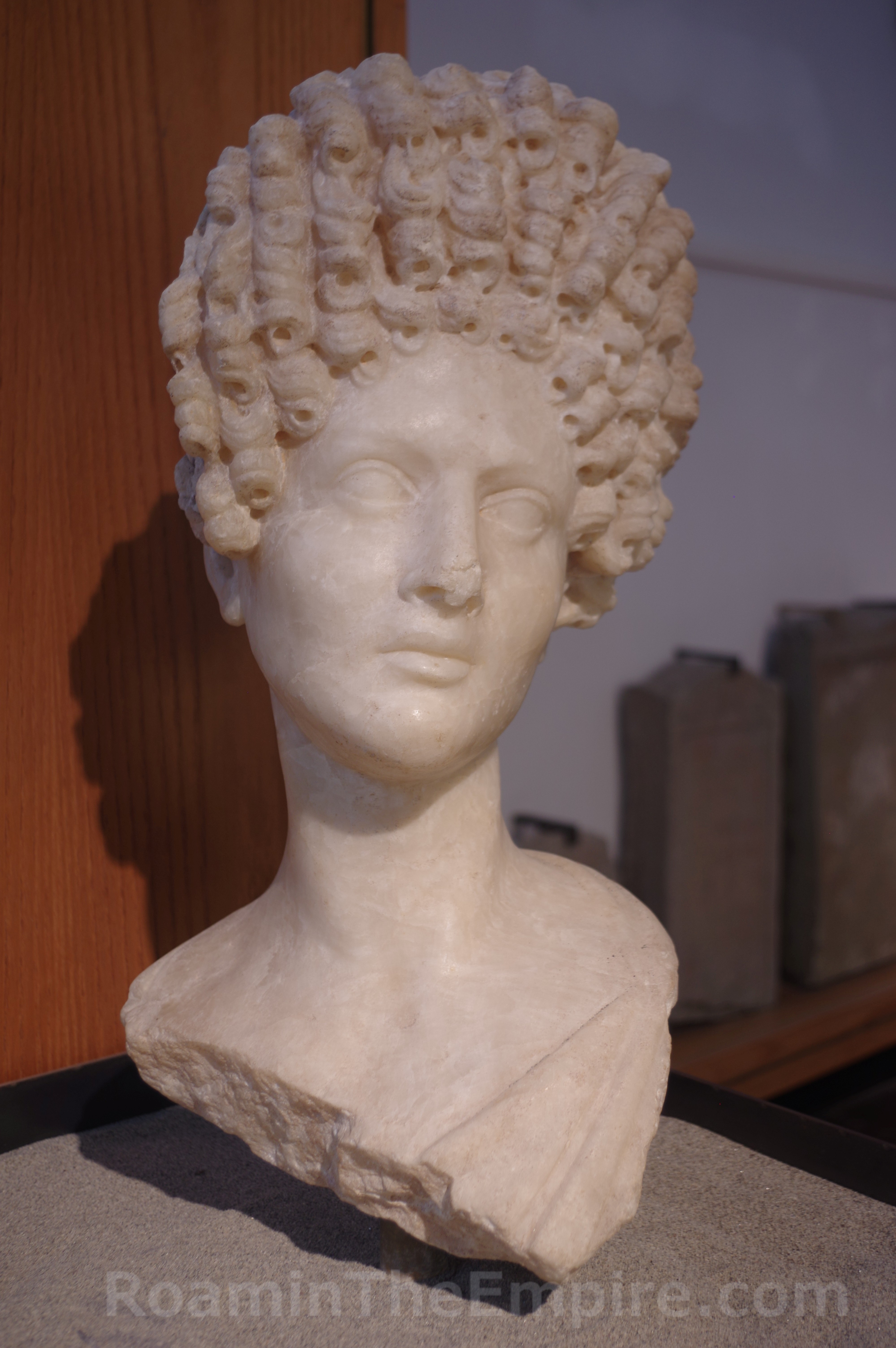
As would be expected, much of the material comes from ancient Faesulae and the immediate surroundings. There are a few really nice artifacts in the collection. A lead cysta dating to the 3rd century CE with six decorative reliefs including one depicting gladiators and another depicting officials (perhaps an emperor) donating food to citizens. A partial statue of a weeping Isis. One of the Etruscan boundary stones that mentions an Etruscan name for Faesulae. In addition, there are both Etruscan and Roman cinerary urns, a good collection of smaller bronze figures, funerary elements like inscriptions and stelae, statues and reliefs. Up stairs is a lot of pottery, including some very nice black figure vases.
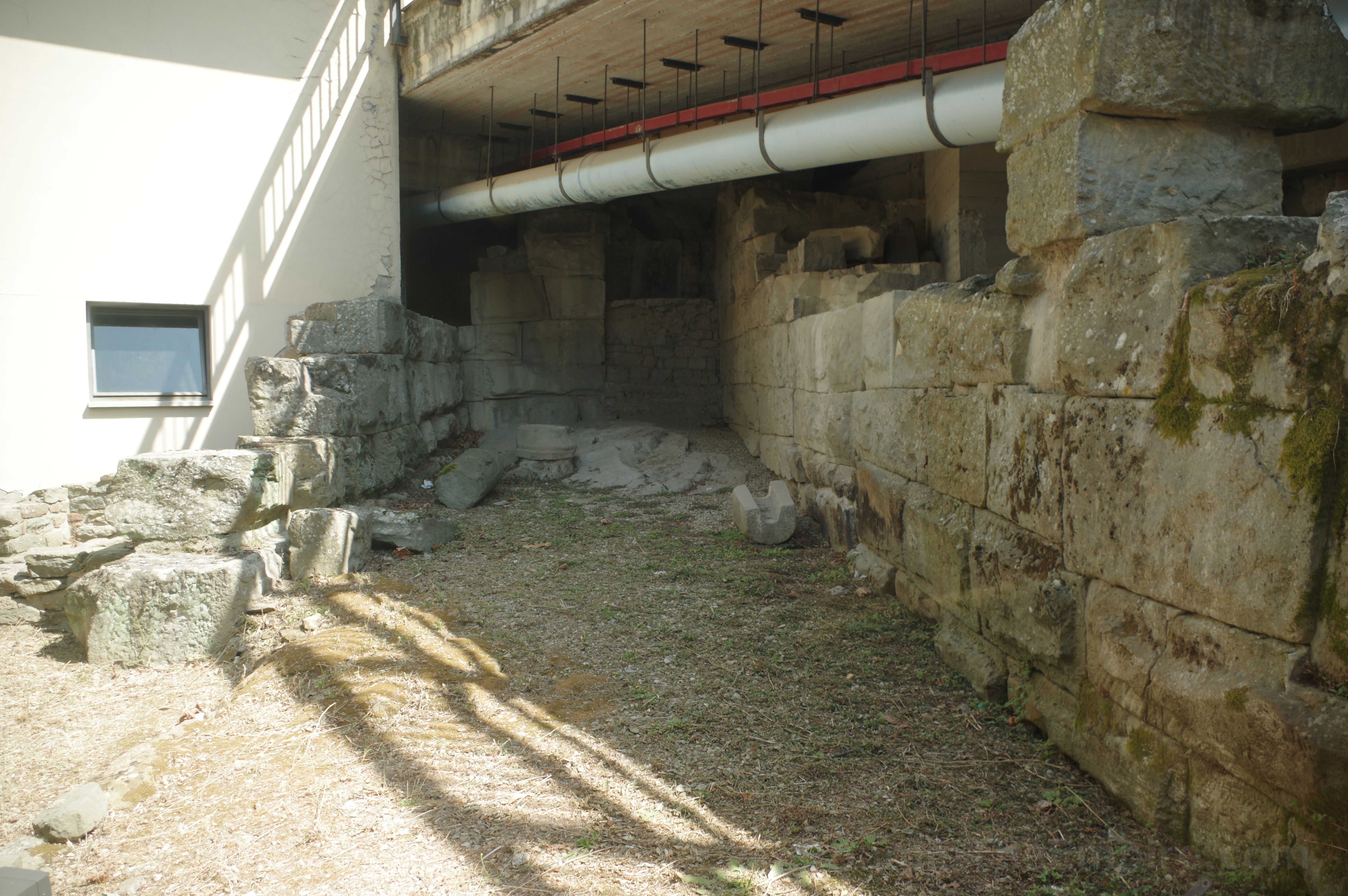
It’s also worth noting in a corner of the museum, some excavated archaeological remnants of in situ architecture can be visited. Down a hallway on the first floor is a reconstruction of a 7th century CE Longobard grave from nearby Piazza Garibaldi. A little farther on are a couple of Hellenistic walls. These are also visible from outside the museum off Via Marini and Via Portagiani, but the best view is from the museum. Given the orientation and structure, these seem to be a continuation of the walls from the Giardino Mangani. Overall, I spent about an hour and a half in the museum. There’s plenty of information, but not so much you’d get bogged down for hours reading it all.
Continued in Faesulae Part II







Sources:
Appian. Bellum Civile, 2.1.3.
Berti, Fede and Andrea Gaucci. “Il Ciottolo con Iscrizione Mi Tular da Spina: Problemi di Contesto e di Interpretazione.” The Etruscans in the Po Valley, Proceedings of the Conference on Etruscan and Italic Studies, Rome: Giorgio Bretschneider, 2024.
Cassius Dio. Historia Romana, 37.30-39.
Grant, Michael. A Guide to the Ancient World: A Dictionary of Classical Place Names. New York: Barnes & Noble Books, 1997
Livy. Ab Urbe Condita, 22.3.
Orandini, Silivia and Angela Passigli (Eds.). Fiesole Archeologica. Milan Italy: Idea Books, 1990.
Polybius. Historiai, 2.25.
Procopius. De Bellis, 6.23-27.
Sallust. Bellum Catilinae, 24, 27, 30, 59-60.
Smith, William. Dictionary of Greek and Roman Geography. Walton & Murray, 1870.
Stillwell, Richard, William L. MacDonald, and Marian Holland. McAllister. The Princeton Encyclopedia of Classical Sites. Princeton, NJ: Princeton U Press, 1976.