


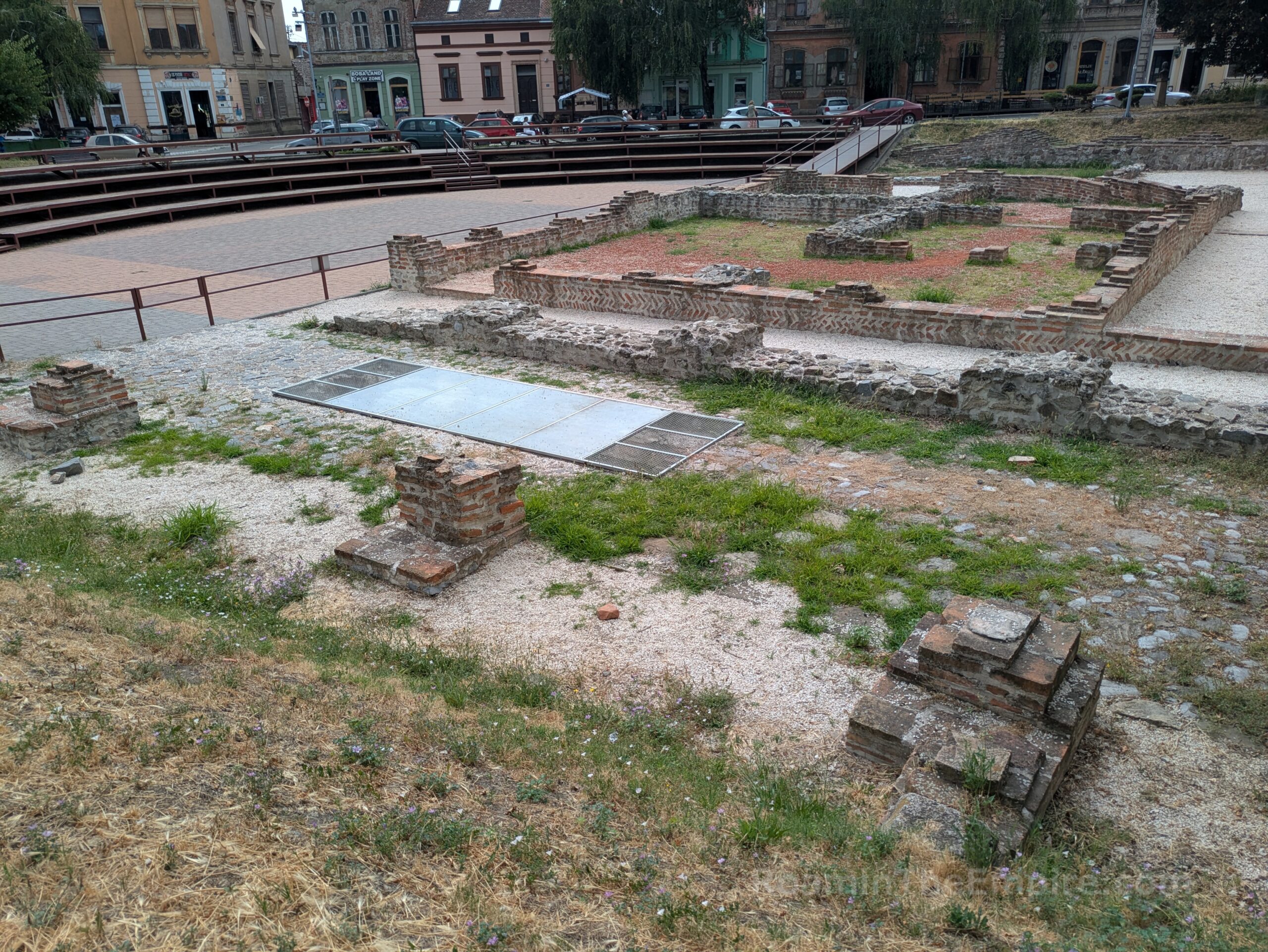
Most Recent Visit: July 2025
The Roman settlement of Sirmium was located on the left bank of the Savus (modern Sava) near its confluence with the Bacuntius (modern Bosut). Today, the modern city of Sremska Mitrovica, Serbia occupies the site of the ancient city. The region in which Sremska Mitrovica is located, Syrmia (Srem or Srijem), is derived from the name of the ancient city, as is the Sremska portion of the modern city’s name. The etymology of Sirmium is sometimes attributed to a foundation by the 4th century BCE king of the Thracian Triballi tribe, but this seems to have been a later association between the names and did not have any historical or mythological basis. More likely the name is probably derived from a Proto-Indo-European root meaning flowing water, which was probably a reference to the Savus.
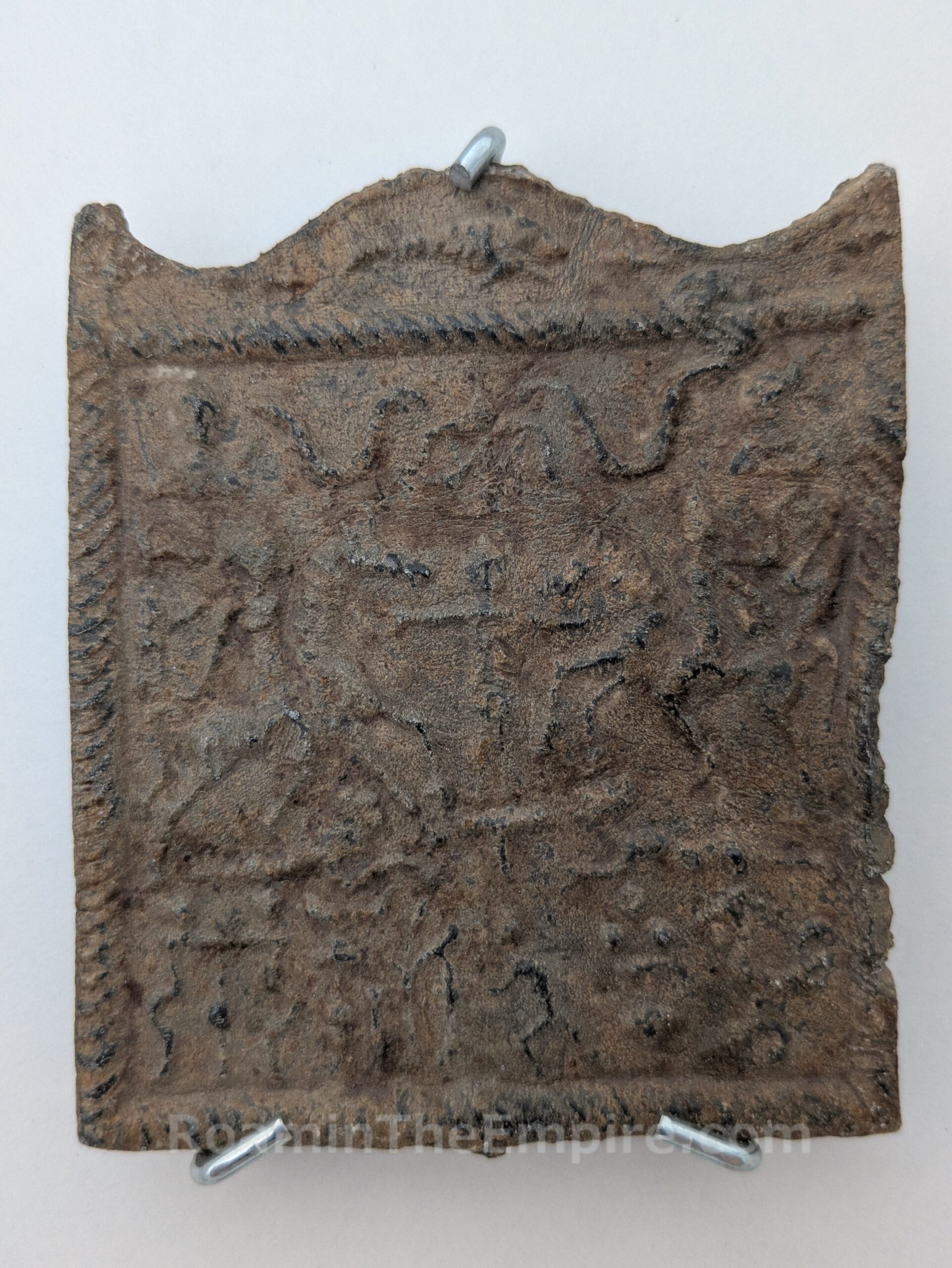
Prior to the arrival of the Romans, Sirmium was located in the territory of the Pannonian-Illyrian tribe of the Amantini, and according to Pliny the Elder, the Sirmienses. The Sirmienses only seem to be mentioned by Pliny, though, and one has to wonder if it was a later assumption by the writer based on the name of the settlement and the typical Roman habit of tying the chief settlement of an area to the name of the tribe that inhabited it. The Amatini seem to have come into conflict with Rome during the Bellum Pannonicum in 14 BCE, when a number of Pannonian tribes supported the Delmetae in their ongoing conflicts with Rome. Marcus Vinicius, governor of Illyricum, was said to have subdued the area between the Savus and Dravus (modern Drava) river in 14 BCE. This would seemingly have included the Amantini and Sirmium (or rather its Amantini predecessor). Uprisings in the area continued through 10 BCE and were alternatively dealt with by Marcus Vipsanius Agrippa and the future emperor Tiberius. Sometime during this period, Sirmium came under Roman control.
In 6 CE, the chieftain Bato of the Daesitatae revolted against Rome. After an early victory against local Roman forces, he was joined by a number of other tribes including primarily the Breuci, led by their own Bato (leading to the conflict sometimes being called the Bellum Batonianum). The Breuci were neighbors of the Amantini, who seem to have remained loyal to Rome, and marched on Sirmium in the first year of the war. The governor of Moesia, Aulus Caecina Severus, broke the siege on Sirmium and drove the Breuci out of the area. Shortly after this episode, sometime around 8 CE, the province of Pannonia was organized out of the territory of Illyricum and included Sirmium.
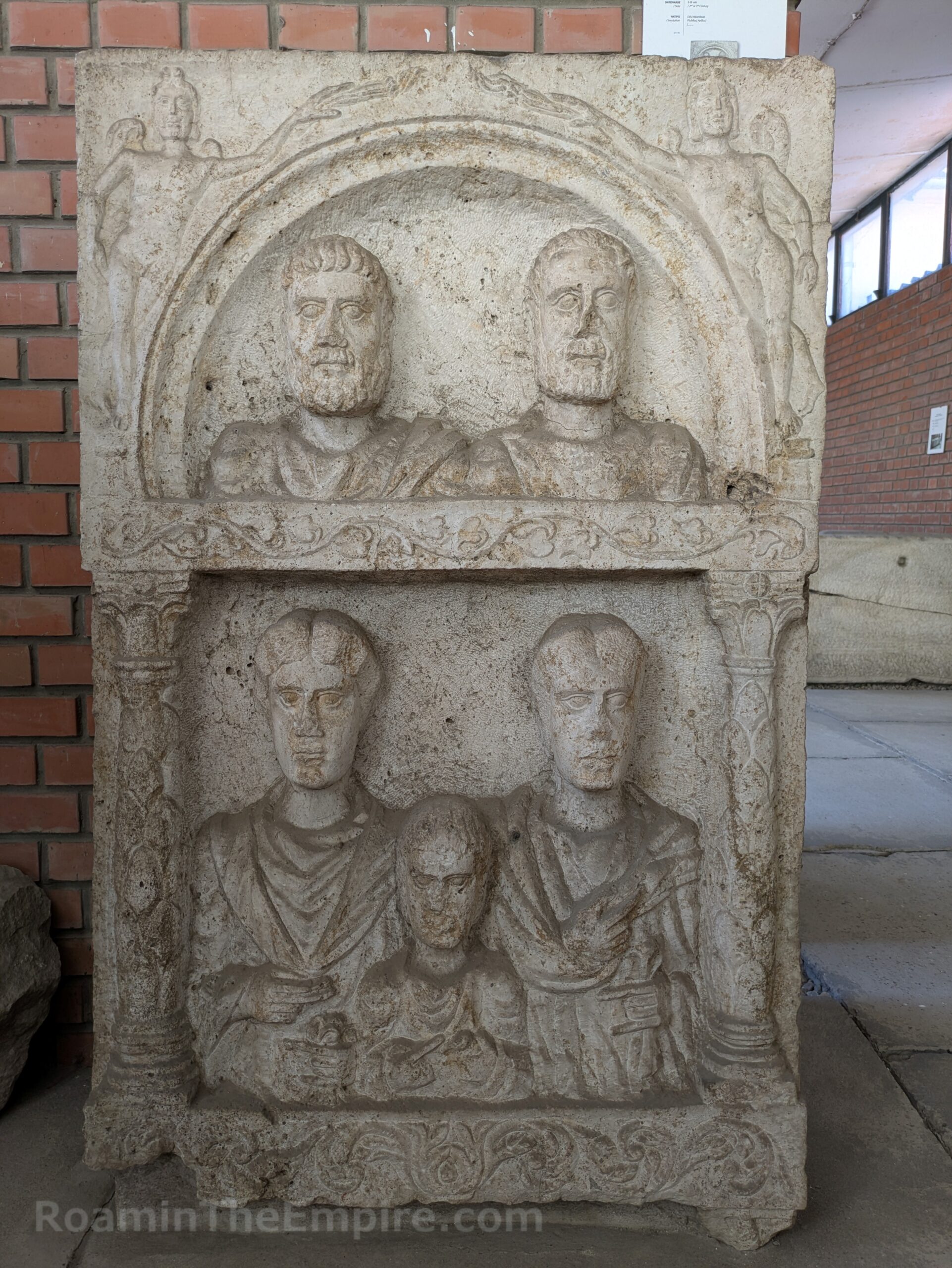
Sirmium became an important administrative center in Pannonia through the 1st century CE. It was a hub of several major routes through the region and was used as a base of operations for military campaigns along the Danubian frontier and hosted visits from emperors. Sometime during the reign of the Flavians, Sirmium seems to have attained colonia status. In 103 CE, Pannonia was divided into Pannonia Inferior and Pannonia Superior, with Sirmium being made the capital of the former. It retained importance through the 2nd century CE, and was notably used as a residence by Marcus Aurelius during his campaigns in Pannonia in the late 2nd century CE.
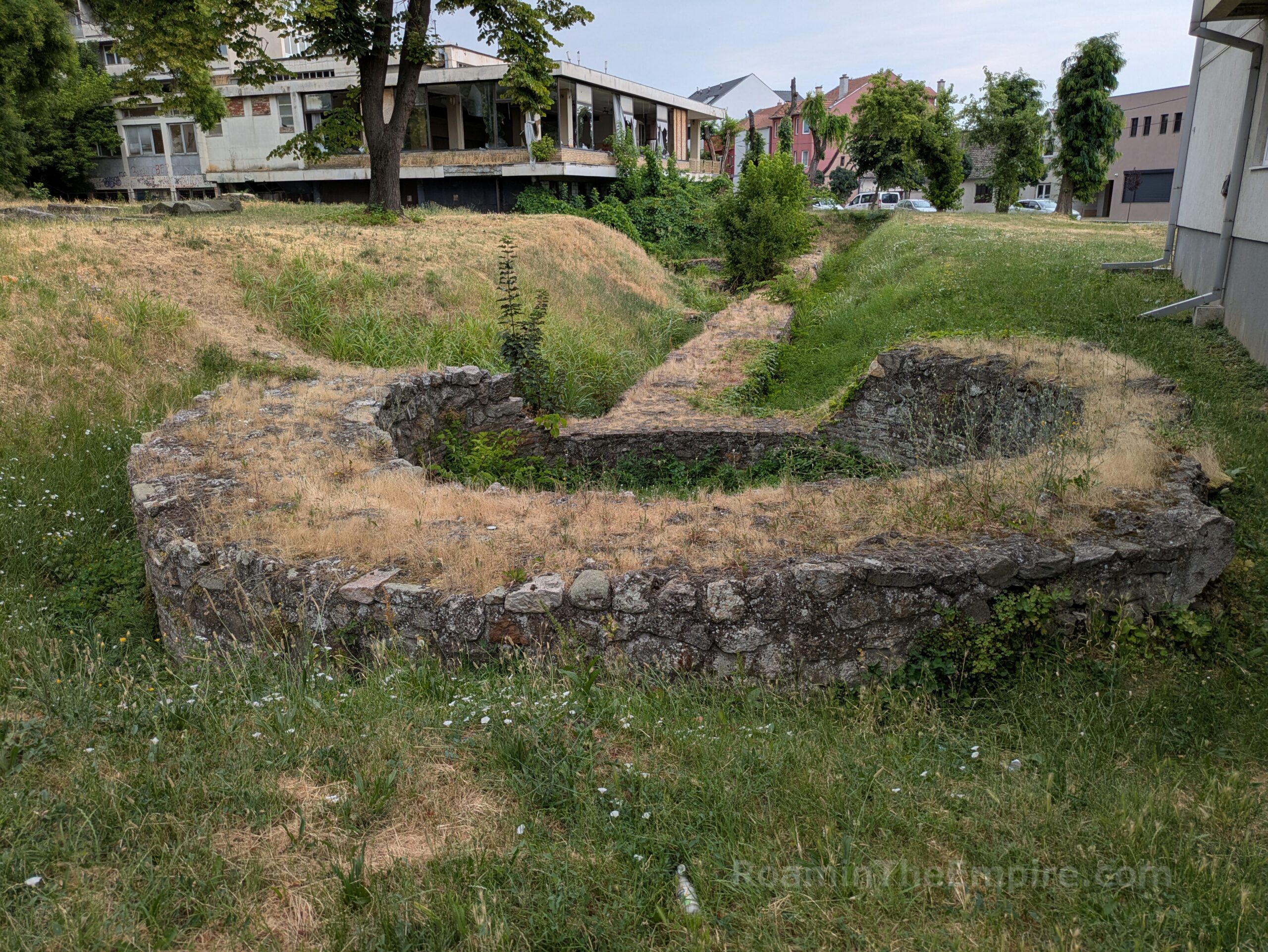
Sirmium became a focal point of imperial politics in the 3rd century CE with a number of future emperors being born (or potentially being born) in the city or its environs and a number of other emperors being proclaimed there. Decius was born in the village of Budalia, just outside Sirmium around 201 CE. His sons, Herrenius Etruscus and Hostilian were born in Sirmium proper, and would be co-rulers with him and his successor, respectively. Sirmium has been cited as a potential birthplace for Claudius Gothicus around 214 CE, though it is far from certain that he was born there. The briefly reigning Quintillus was born in Sirmium and his successor Aurelian was perhaps born there in 214 CE as well (though again it is not certain, but has been cited as one of the better possibilities). The late 3rd century emperor Probus was born there around 230 CE, and Maximianus seems to have been born in the immediate surroundings around 250 CE. The usurpers Igenuus and Regalianus were proclaimed emperors successively in 260 CE In 270 CE Claudius Gothicus died fighting in the vicinity of Sirmium, and not long after Aurelian was proclaimed emperor by his troops there following the death of Gothicus’ successor, Quintillus. Probus was assassinated by his own troops in Sirmium in 282 CE, following the proclamation of the commander of the Praetorian Guard, Marcus Aurelius Carus, as emperor.
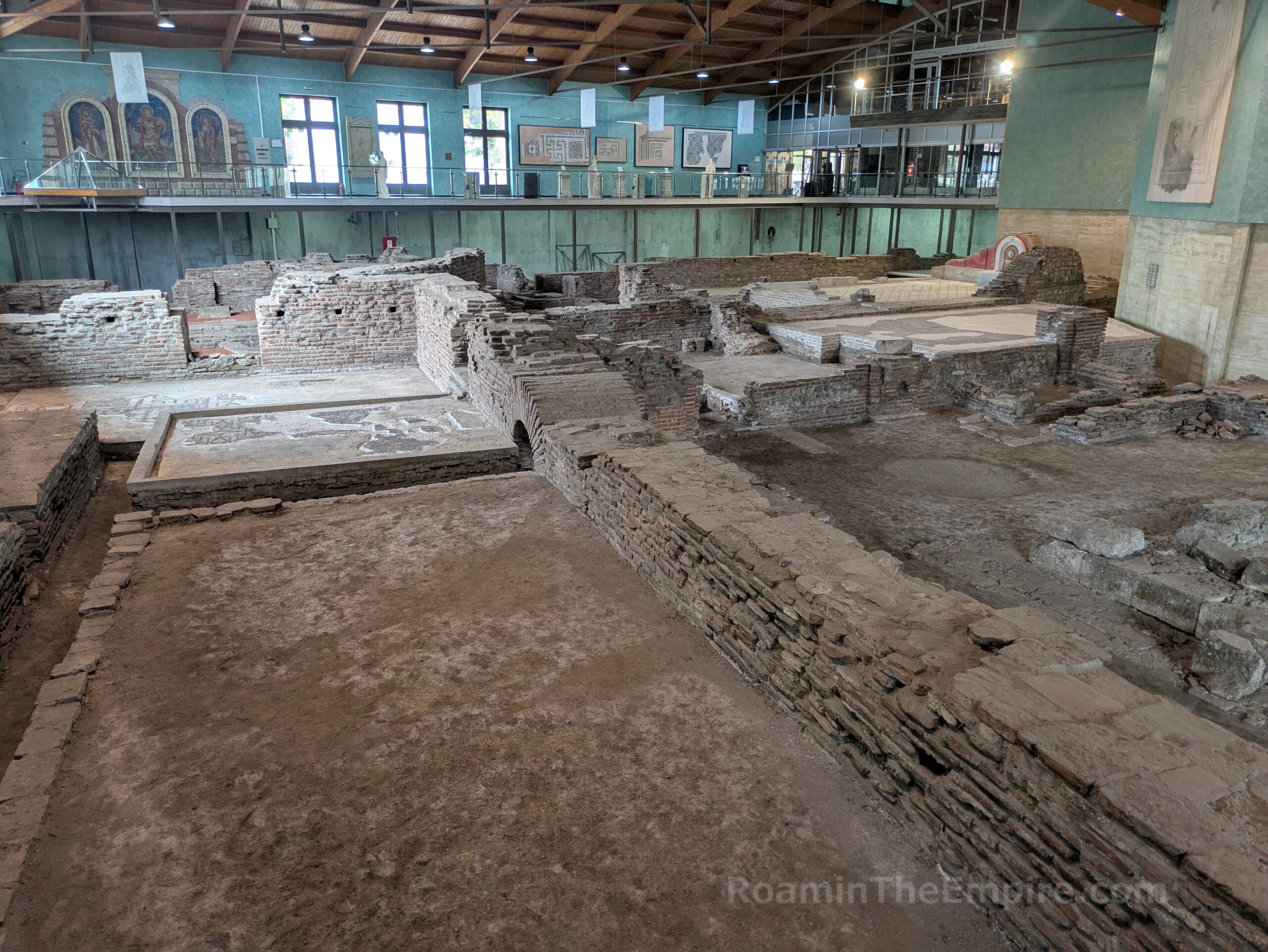
In 293 CE, the tetrarchy was established and Sirmium became one of the four capital cities of the empire along with Augusta Treverorum, Mediolanum, and Nicomedia. Galerius ruled his portion of the empire from the city. Diocletian divided Pannonia into four provinces a few years later in 296 CE, with Sirmium becoming the capital of Pannonia Secunda. Following the Battle of Cibalae between Constantine and Licinius in 316 CE, Licinius was forced to retreat and regroup at Sirmium following his loss. Crispus and Constantine II were both proclaimed Caesars in Sirmium in 317 CE, while that same year Constantius II was born there. When the empire was reorganized and divided up into 4 praetorian prefectures in 319 CE, Sirmium became the capital of the prefecture of Illyricum, encompassing Pannonia and the present-day Balkans.
The future emperor Gratian was born in the city on April 18, 359 CE. Both Ammianus Marcellinus and Zosimus record that following Valentinian’s death in 375 CE (who had been born in nearby Cibalae), a lighting strike set fire to and destroyed the curia, forum, and part of the imperial palace. In January of 379 CE, Theodosius I was proclaimed as emperor while in Sirmium. Sometime that same year, Sirmium and the western portions of Pannonia were removed from Illyricum and reassigned to the prefecture of Italia. Fractures in the west due to Germanic incursions resulted in the eastern empire taking control of the city in the early 5th century before it was finally conquered by the Goths around 441 CE.
Getting There: Sremska Mitrovica is about 65 kilometers from the capital of Serbia, Belgrade. There are several train and bus departures daily that leave from the Novi Beograd bus/train station in Belgrade with service to Sremska Mitrovica and vice versa. Unfortunately the bus schedule doesn’t seem to be well documented online, but I found that the buses were surprisingly more expensive than the train, but seemed to be more frequent. The buses seemed to average about 1800-2000 Serbian Dinar (RSD) while the trains were more like 1200 RSD. The train schedule is more regular and can be found at this website. Both options take between an hour and an hour and a half.
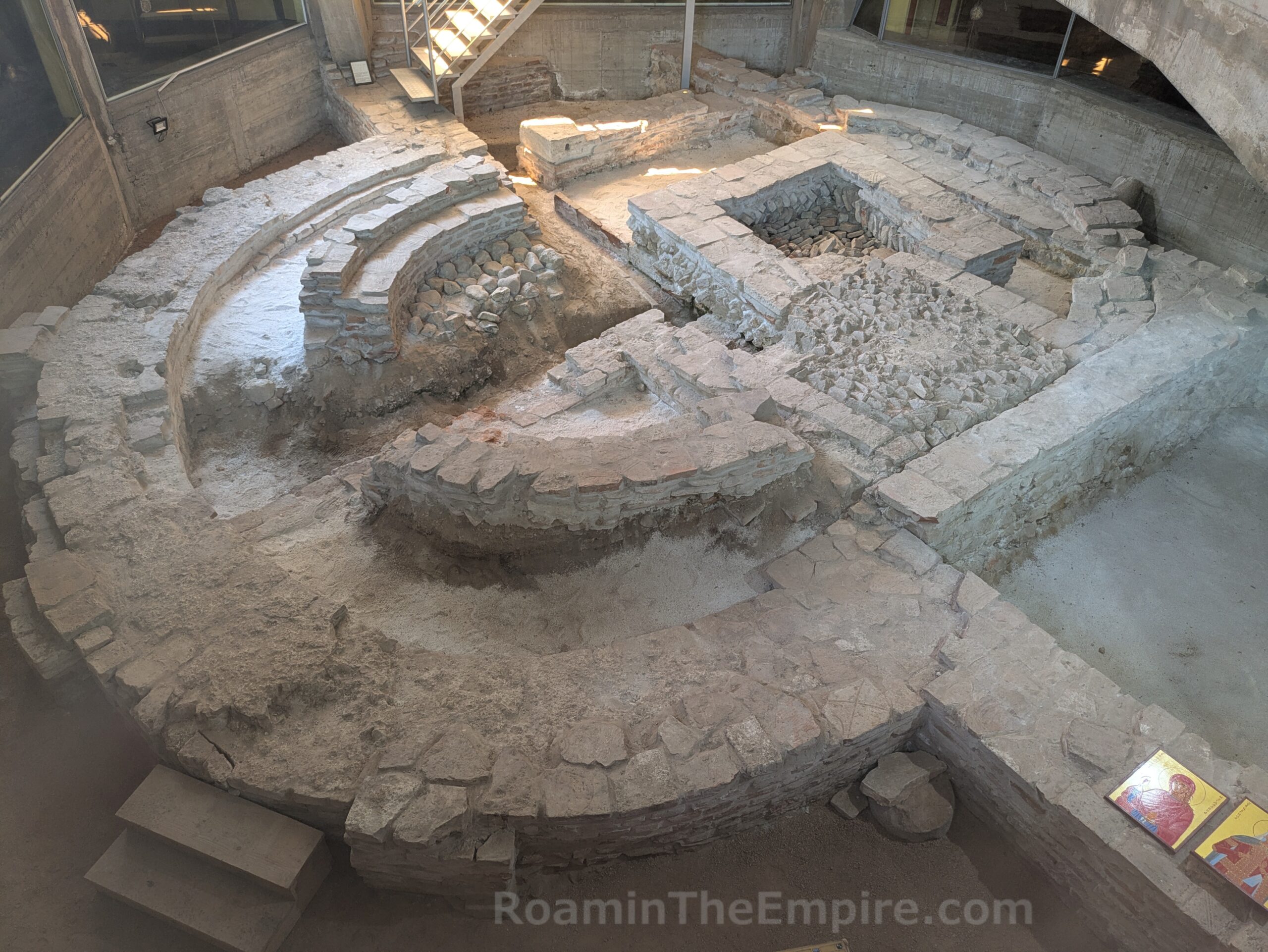
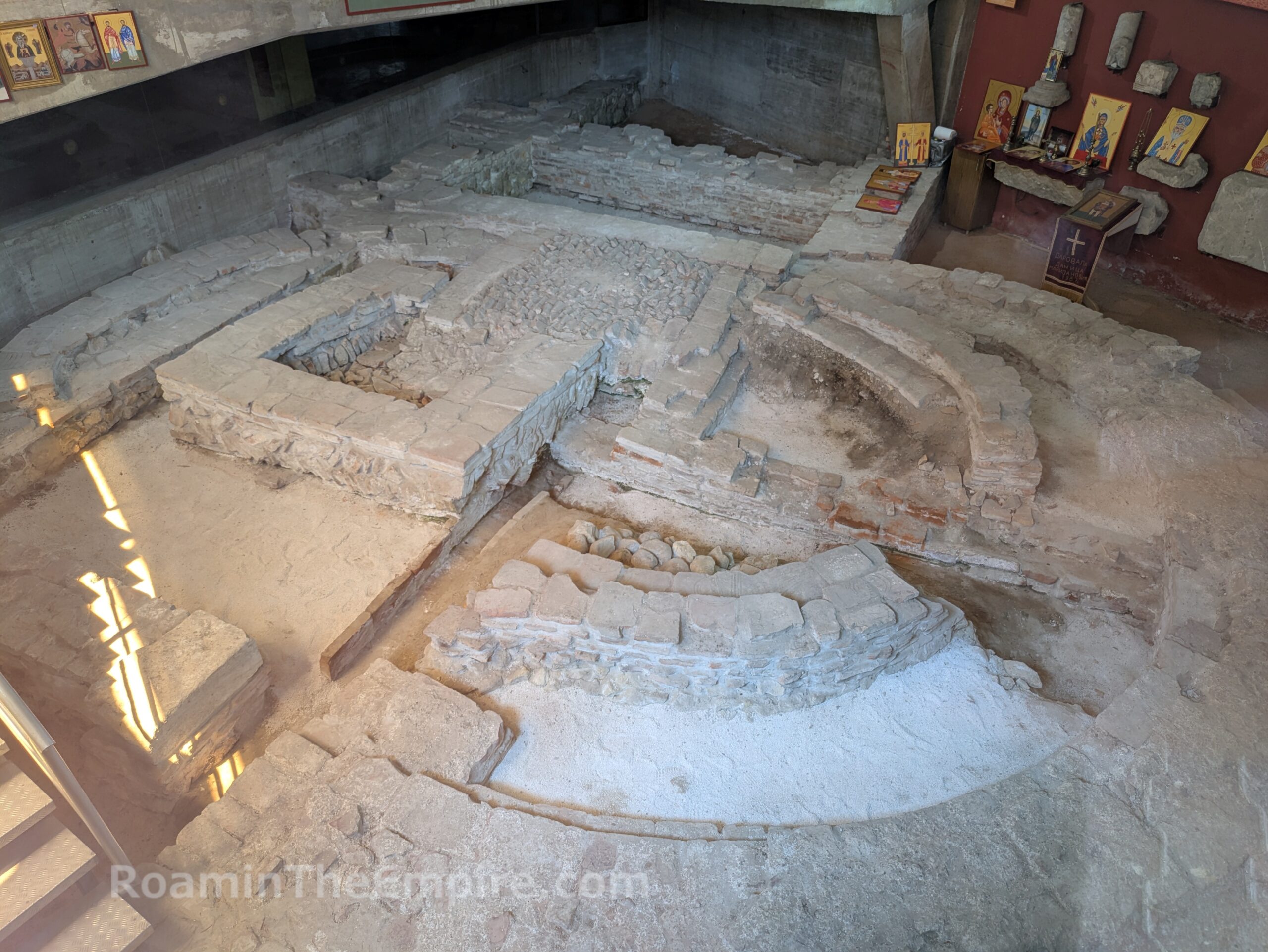
Sremska Mitrovica readily embraces its ancient heritage, with a number of businesses incorporating the ancient name, including the city bus service. Though many remnants of the ancient city have been found, only a few can be visited. When approaching the historic center of Sremska Mitrovica by foot from the train or bus station, the first vestige of the ancient city are the remains of the 5th century CE Basilica of St. Demitrius. The remains of the Christian basilica are tucked beneath a building off the west side of Trg Vojvođanskih Brigada. Unfortunately, it seems to have very limited hours of operation. It’s an active religious site that only seems to be accessible on Sunday from around 17:30 to 16:00. There are large glass windows at street level, though, and it can be seen pretty well even when there is no direct access. The basilica was built between 426 CE and 441 CE. The more robust semicircle wall of the apse and a small portion of an adjacent wall are all that remain from the original building, with the other constructions being from later iterations of the church.
Continued In Sirmium Part II
Sources:
Ammianus Marcellinus. Res Gestae, 1.5.16, 16.10.20, 17.12-13, 18.4.1, 19.11.1, 21.9-11, 25..8.9, 26.5-6, 31.11.6.
Aurelius Victor. Epitome de Caesaribus, 37, 40.10, 47-48.
Cassius Dio. Historia Romana, 55.29.3.
Eutropius. Breviarium Historiae Romanae, 9.17.
Flavius Vopiscus Syracusanus. Scriptores Historiae Augustae – Aurelian, 3.
Flavius Vopiscus Syracusanus. Scriptores Historiae Augustae – Probus, 3, 18, 21.
Grant, Michael. A Guide to the Ancient World: A Dictionary of Classical Place Names. New York: Barnes & Noble Books, 1997.
Herodian. Ab Excessu Divi Marci, 7.2.1.
John Malalas. Chronographia, 12.299, 12.302, 18.450.
Jordanes. Getica, 300.
Philostratus. Vitae Sophistarum, 2.1.7.
Pliny the Elder. Historiae Naturalis, 3.148.
Pop-Lazić, Stefan and Bojan Popović. “New Results of Excavations of the Imperial Palace in Sirmium.” Pannonia Underground: Proceedings of the international conference held at Szombathely, 25-26 November 2021, Szilvia Biro (ed.), Szombathely: Savaria Museum, 2022.
Procopius. Anecdota, 18.16.
Procopius. De Bellis, 5.3.10, 5.11.5, 5.15, 7.34.
Smith, William. Dictionary of Greek and Roman Geography. Walton & Murray, 1870.
Sozomenus. Historia Ecclesiastica, 4.1-22.
Stillwell, Richard, William L. MacDonald, and Marian Holland. McAllister. The Princeton Encyclopedia of Classical Sites. Princeton, NJ: Princeton U Press, 1976.
Zosimus. Historia Nova, 2.18-19, 3.10-11, 4.18.