



Most Recent Visit: June 2025
Prior to the arrival of the Romans, the area of Colonia Martia Iulia Valeria Salona was part of the territory of the Dalmatae, an Illyrian tribe whose territory and name would later become the basis for the Roman province and modern region of Dalmatia. The Dalmatae seem to have broken off from the larger confederation of Illyrian tribes in the early 2nd century BCE after a disagreement regarding the succession of Gentius to the Illyrian throne following the death of his father, Pleuratus III in 181 BCE. The Dalmatae had heavy Hellenistic influence due to the proximity of Greek colonies and trading emporia along the coast including Tragurion (later Tragurium and now Trogir), Spalathos (modern Split), Issa (modern Vis) and Epetion (modern Stobreč) founded in the 4th and 3rd centuries BCE.
Almost immediately after asserting their independence from the greater confederation of the Illyrians, the Delmatae began expanding their territory at the expense of other Illyrian tribes and the Liburni. As the Romans began expanding into the territory of Illyria around the same time, this quickly brought the Delmatae and Romans into conflict. In 156 BCE the Delmatae attacked Illyrian subjects of Rome and sparked the first of three wars between the Delmatae and Romans. The first war ended a year later, resulting in the destruction of the capital city of Delminium (modern Tomislavgrad, Bosnia and Herzegovina) by the consul Scipio Nasica. After the destruction of Delminium, Salona seems to have become the principal city of the Delmetae.
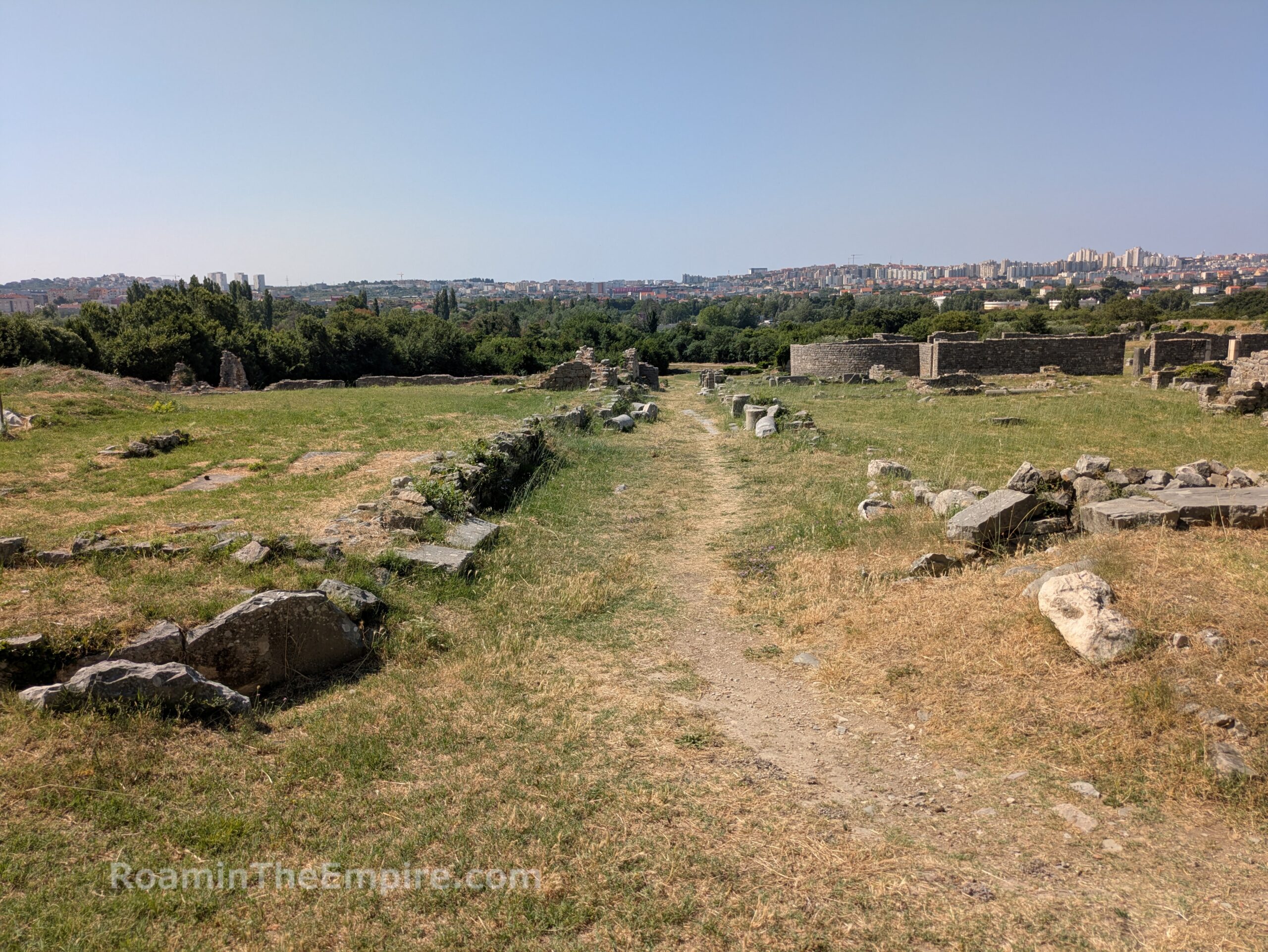
A second war was fought in 119-118 BCE, apparently with no precipitating factor other than the consul Lucius Caecilius Metellus wanted a triumph and had to manufacture a conflict. The Delmatae don’t seem to have put up much of a fight and Metellus wintered his army at Salona (and later got the triumph he desired). The third and final war between the two occurred in between 78 and 76 BCE, with Salona besieged and captured by Gaius Cosconius, ending the conflict. Roman settled at Solona as part of a conventus civium Romanorum following the conflict, which was incorporated into the Roman territory of Illyricum. Julius Caesar became the proconsul of the joint territories of Gaul and Illyricum in 58 BCE, and while he was engaged in his Gallic campaigns, the Delmatae took the opportunity to wage war against their neighbors. During the civil war between Caesar and Pompey, the Delmatae generally took the side of Pompey, though cities with strong Roman populations like Salona supported Caesar. An admiral of Pompey, Marcus Octavius attempted to capture Salona in 48 BCE, but he was driven away. Caesar’s general Aulus Gabinius died in Salona around that time after losing a battle and retreating to the city.
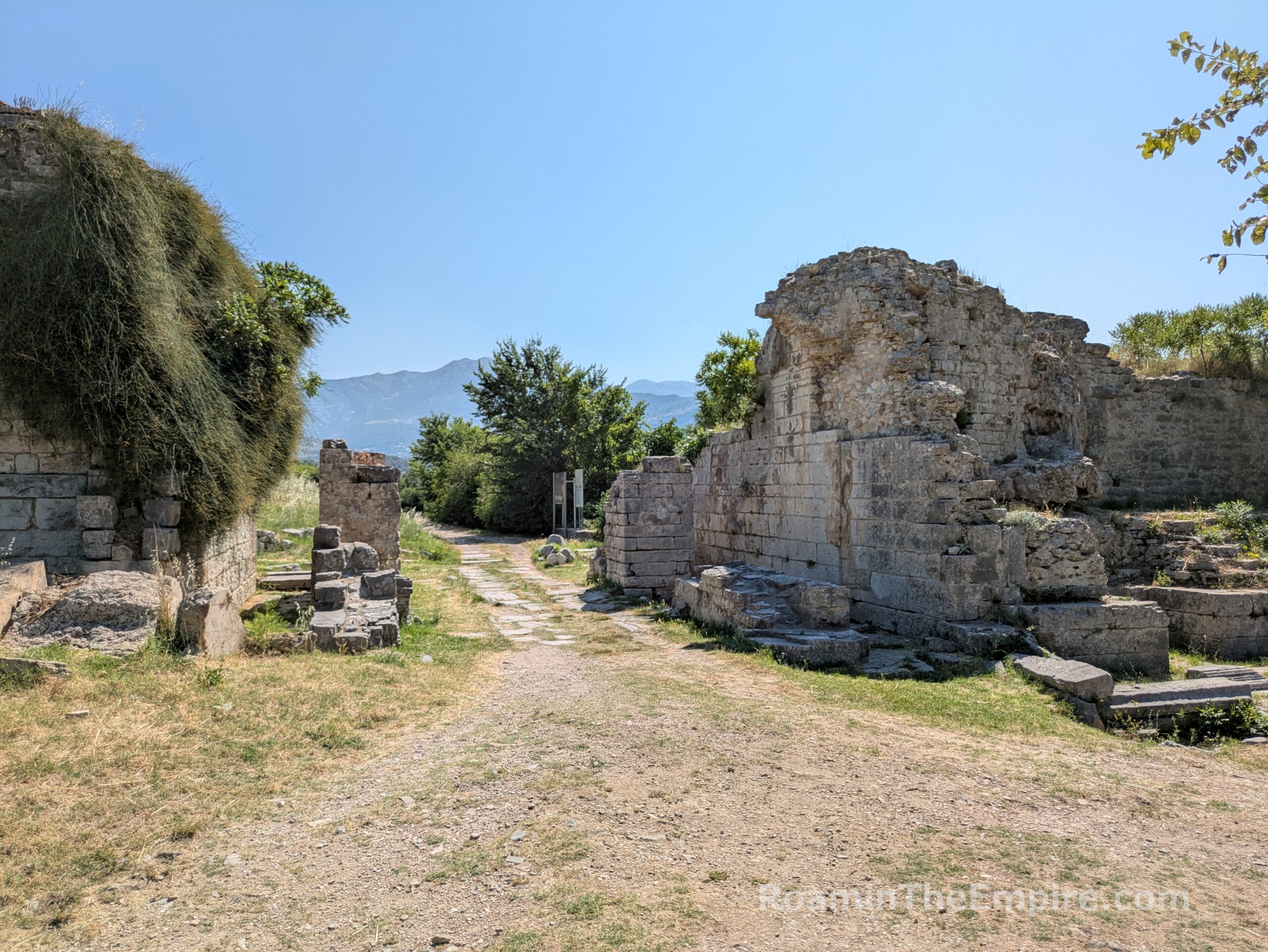
As reward for their support against Pompey, it seems that Caesar established Colonia Martia Iulia Valeria Salona around 47 BCE. When the province of Illyricum was established early in the reign of Augustus, Salona became the capital city. Continuing unrest in the area seems to have resulted in the Delmatae, who unsurprisingly supported the liberatores in the civil war following Caesar’s assassination, taking control of the new Roman colony in the mid to late 40’s BCE. It was recaptured by the consul Gaius Asinius Pollio in either 40 or 39 BCE, and he named his son who was born that year Saloninus. Salona was again besieged in 6 CE by the Daesitiate leader Bato during the Great Illyrian revolt (Bellum Batonianum), but the city held out and was not captured.
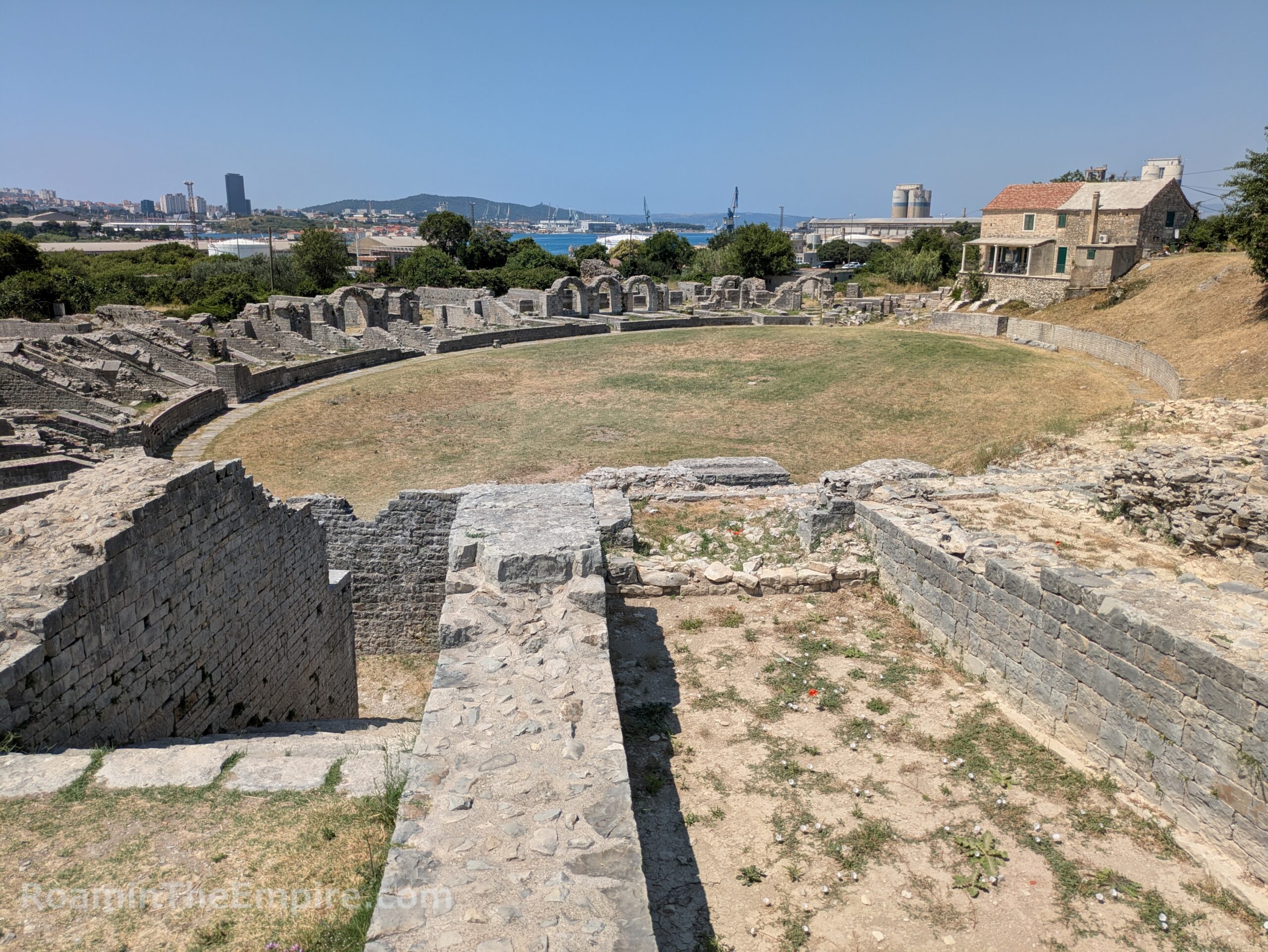
Solona quickly became a hub for the province and region, with most major routes converging at the city. When Illyricum was dissolved into Pannonia and Dalmatia sometime in the first half of the 1st century CE, Salona again became capital of the latter province. By the 2nd century CE, it likely had a population of about 60,000 inhabitants. On December 22, sometime between 242 and 245 CE, the future emperor Diocletian was born in, or in the environs, of Salona. When he came to power in 284 CE, his birthplace benefitted greatly from his patronage. When Diocletian retired in 305 CE, he built his elaborate palace next to the sea just a few kilometers from Salona, near where the Greek colony of Spalathos was located.
The city continued to prosper through the 4th and 5th centuries CE. Salona became the capital of a semi-independent Dalmatia under Marcellinus in 454 CE after he rebelled against the Western Emperor Valentinian III. It remained as such after his death, when his nephew Julius Nepos, who had been born in Salona, inherited the position. After a brief reign as Western Emperor in 274-275, Nepos returned to Dalmatia until his death in 480 CE, after which the semi-independent province was controlled by the Herulian King Odoacer. The city was destroyed by the Avars in 639 CE, and the remaining population deserted Salona in favor of the remains of the nearby fortress-like Palace of Diocletian.
Getting There: Today the core of ancient Salona is located in Solin, a suburb of Split. From the old town of Split, bus #1 runs frequently during the day (every half an hour) from just outside the walls of Diocletian’s Palace at the HNK stop at Trg Gaje Bulata. The trip is just under a half an hour and drops off just outside the park at the Starine Salona 1 stop. Purchased through their app, the ticket is 1 Euro, while cash from the bus driver is 3 Euro.
Most, but not all of the ancient remains of Salona are contained within an archaeological park located at Ulica don Frane Bulića 91. It’s sort of hidden behind the parking lot for the adjacent hotel, which was not there when I first visited the site in August 2012. If driving to the site, the site parking lot is located in the dirt parking area south of the paved hotel parking. The site is open Monday through Sunday in the summer (June 1 through September 30) from 9:00 to 20:00. The rest of the year it is open Monday through Sunday from 9:00 to 18:00. Tickets are 8 Euros for just the site, or 10 Euros for the site and the Archaeological Museum in Split.
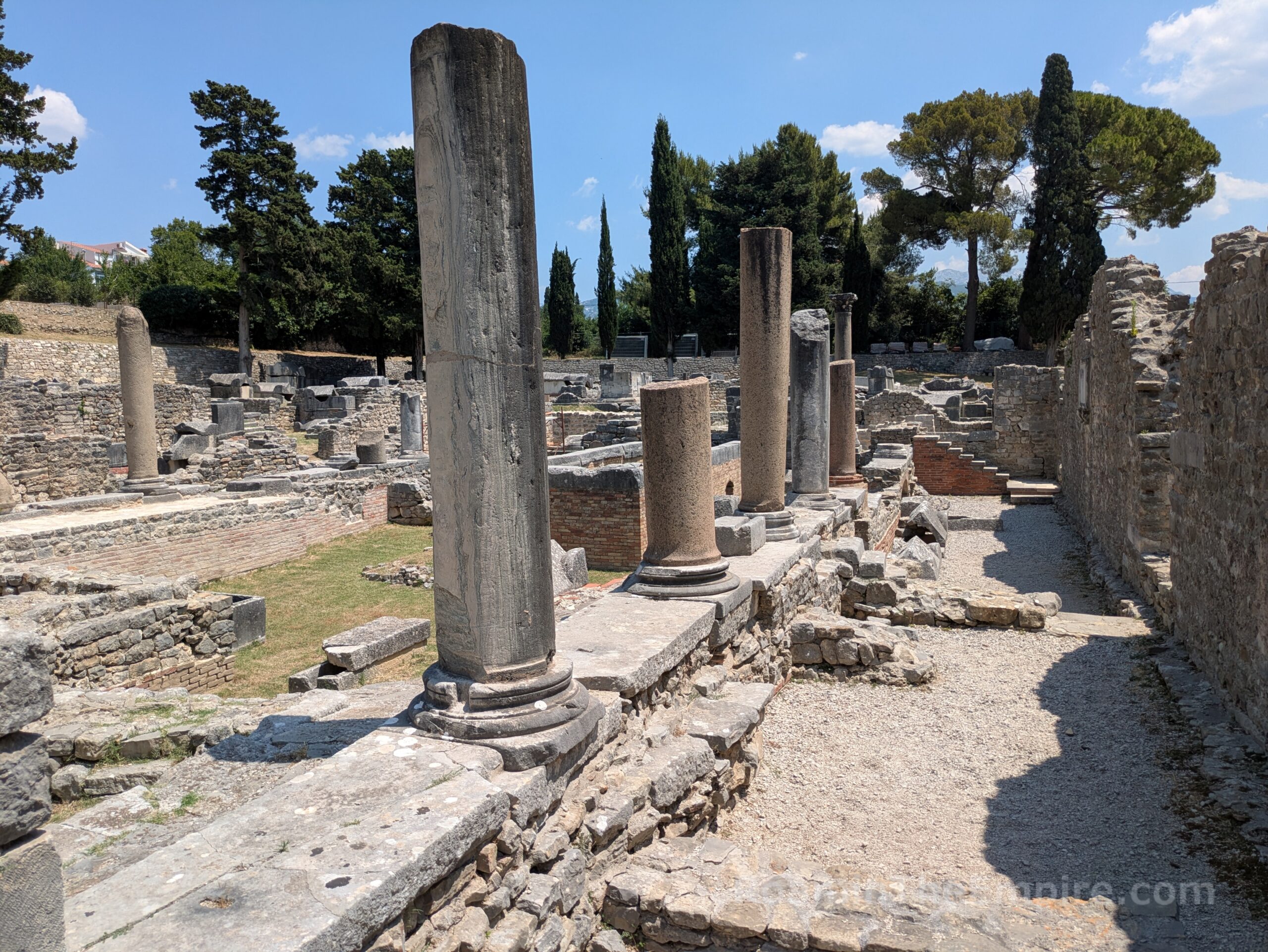
The ticket booth near the parking lot is sometimes open, but sometimes it is not staffed and tickets are purchased at the Tusculum house, which is located about 100 meters into the site past the first set of remains; the Manastrine complex. This area has habitation dating back to the 2nd century BCE, but starting in the 1st century CE began being used as a necropolis. In 284 CE, the Syrian missionary Dominius became bishop of Salona, and on April 10, 304 CE he was executed by beheading in the amphitheater on the order of the governor Marcus Aurelius Julius as part of Christian executions mandated by Diocletian. Dominius was buried in this cemetery outside the north walls of Salona, which then became the preferred burial area for his successors and other Christians. In the middle of the 4th century CE, a simple chapel on the site of the tomb as Dominius was venerated as a saint. This chapel was destroyed toward the end of the 4th century CE and in the middle of the 5th century CE a large basilica with three naves was constructed in its place. In the late 6th or early 7th century CE, that basilica was destroyed and subsequently rebuilt.
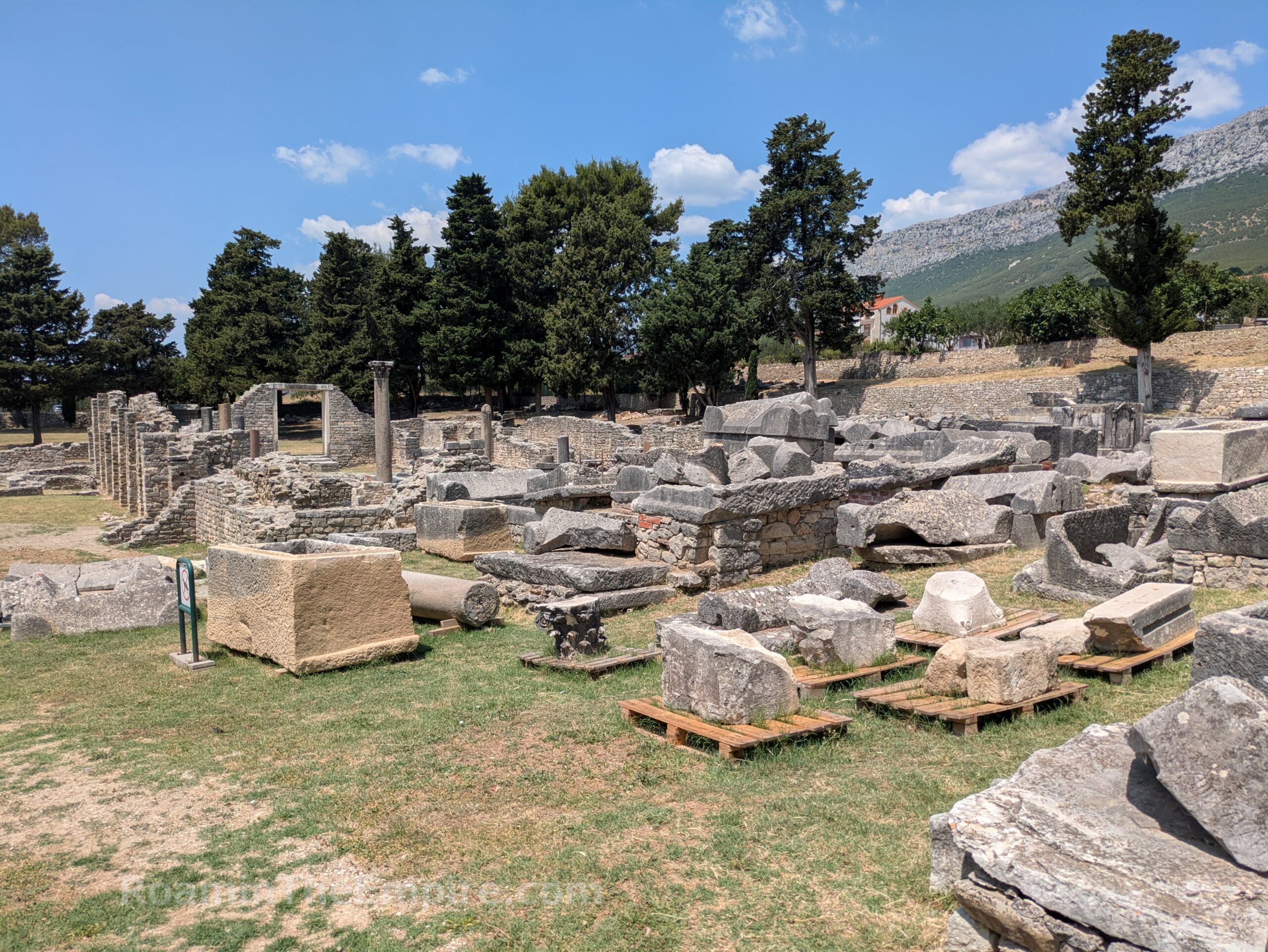
Tombs of various periods and styles are scattered around the exterior area of the remains of the basilica, as well as a few sarcophagi at the west end. The most well-preserved elements of the basilica date to the middle of the 5th century CE, as well as the 6th century CE addition located at the far west end of the basilica. The apsidal rooms around the outside of the core of the basilica are part of the series of chapels dating to the 4th century CE. Contained within the apse at the east end of the 5th century CE basilica is the presbytery, which contains the tombs of Dominius and other important church figures, though burials are located throughout the basilica. Dominius’ tomb is the larger tomb in the south part of the area with a protective glass cover over the entrance. Beyond the eastern side of the basilica are pagan tombs dating between the 1st and 3rd century CE.

South of the Manastrine complex is the Tusculum house. This serves as the offices for the site and is where tickets can be purchased if the booth at the entrance to the site is closed. The building also houses the gift shop as well as a few artifacts. Namely, in the area of the gift shop there are a few mosaics mounted on the walls. There’s also a statue on display. Unfortunately, there’s not much care given to the way they’re displayed as they’re kind of relegated to corners or behind other things. They’re worth seeing, nonetheless.
About 120 meters south of the Tusculum house are the northern fortification walls of Salona. The original circuit of walls that enclosed the city seems to have been constructed in the 2nd century BCE. Alterations and reinforcements were made during the time of Augustus. The city expanded well beyond the walls in the 1st and 2nd centuries CE as relative peace in the area negated the need for walls. As the threat of Germanic tribes increased toward the end of the 2nd century CE, the walls were rebuilt and expanded to enclose the expanded suburbs of Salona during the reign of Marcus Aurelius. Inscriptions record the First and Second Delmatae cohorts as well as the cavalry detachments of Legio II Pia Fidelis and Legio III Concordia as having built portions of the walls. The total circuit of the walls reached a little over 4 kilometers with this expansion, incorporating some existing buildings and structures (such as the amphitheater). Reconstructions and repairs occurred in the next few centuries, including during the reign of Theodosius II.

A small portion of the exterior side of this northern stretch of the walls has been excavated adjacent to a gate in the northern walls. Two towers with triangular protrusions are visible; the western of these with a double protrusion. These triangular constructions were added in the first half of the 6th century CE after a Byzantine conquest of the city. Fragments of the walls can also be seen along the road (Put Salone) that runs east from this section of the walls and out toward the Porta Andetria. The boundaries of the park are not really clear here, as one can essentially take that road in and out of the site and there is no access control. The path west leads along the top of fortification walls as they curve toward the south and the Porta Caesarea.
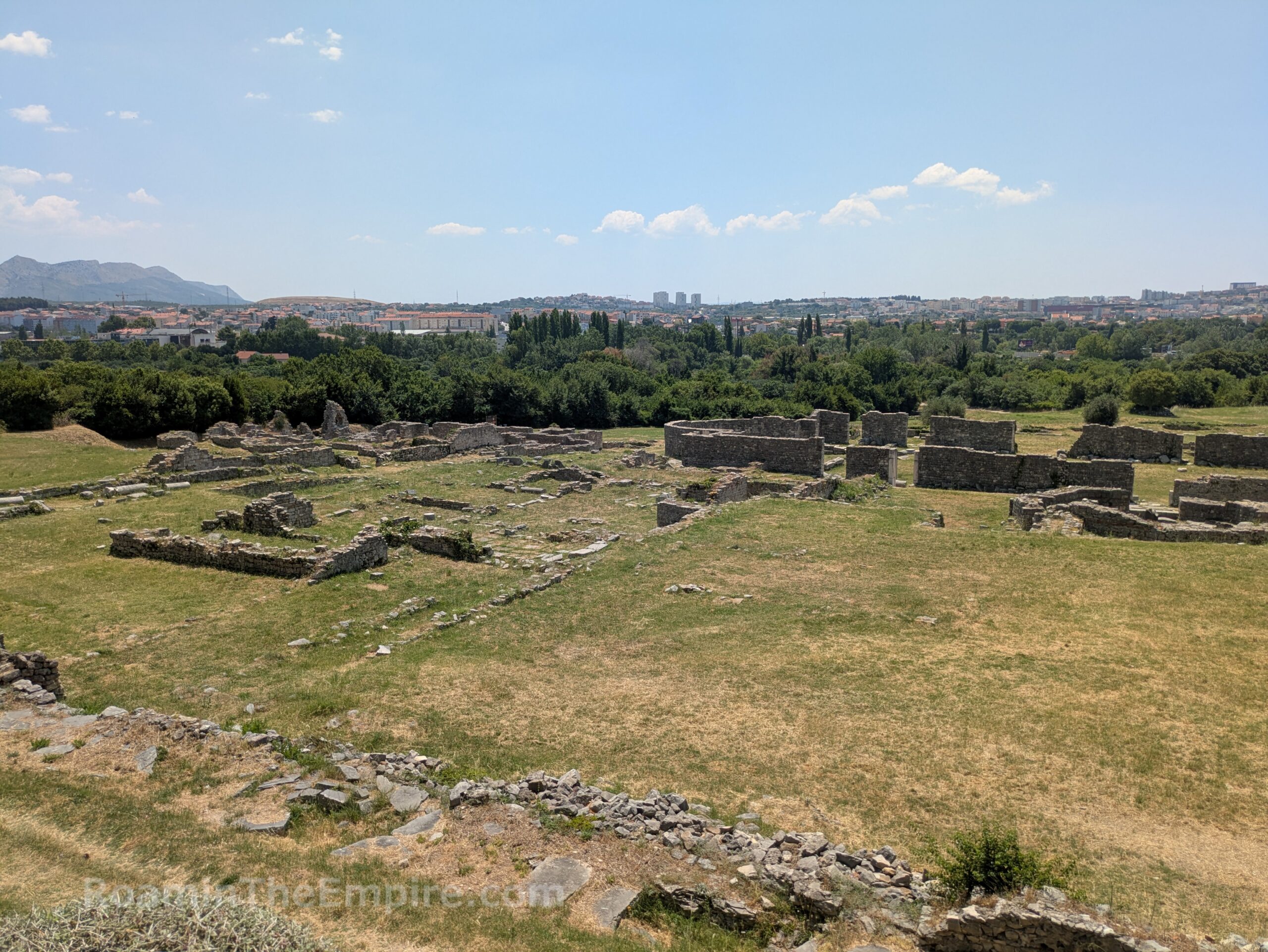
Enclosed within the walls at this northwestern corner of the western circuit of walls, which was a part of the city enclosed in the 2nd century CE expansion, is the so-called Episcopal Center. Starting in the middle of the 3rd century CE, this area of the city became a center for Christian worship. Originally this consisted of semi-private worship spaces; domus ecclesiae. Following the Edict of Milan in 313 CE and the codification of the legal status of Christians in the empire, the neighborhood took on a more official character with the construction of two basilicae, a baptistry, and the bishop’s palace in the following years. Expansions and reconstructions occurred through the 5th and 6th centuries CE.
Continued in Salona, Dalmatia – Part II


Sources:
Appian. Historia Romana, 10.11.
Caesar. Commentarii de Bello Civili, 3.9.
Caesar/Aulus Hirtius. De Bello Alexandrino, 43.
Cassius Dio. Historia Romana, 42.11-12.
Dzino, Danijel. “Asinius Pollio in Dalmatia: What Happened in Salona 39 BCE?” Kilo, Vol. 93, No. 1 (June 2011), pp. 158-166.
Eutropius. Breviarium Historiae Romanae, 6.4, 9.27-28.
Orosius. Historiae Adversus Paganos, 5.20.
Pliny. Historia Naturalis, 3.141.
Smith, William. Dictionary of Greek and Roman Geography. Walton & Murray, 1870.
Stillwell, Richard, William L. MacDonald, and Marian Holland. McAllister. The Princeton Encyclopedia of Classical Sites. Princeton, NJ: Princeton U Press, 1976.
Grant, Michael. A Guide to the Ancient World: A Dictionary of Classical Place Names. New York: Barnes & Noble Books, 1997.
Višić-Ljubić, Ema. Salona Colonia Martia Julia Valeria: A Guide to Archaeological Localities. Solin: Arheološki Muzej Splitu, 2023.